This series of videos presents an abstract from the Croí process where individuals are guided to define their personal (or core) and professional values, and to identify actions they can take that will help them to develop a career that better aligns their personal and professional values and lives.
Benefit of this resource and how to make the best use of it
People establish meaningful connections to sustainability through their personal (or core) values. A new generation of graduates who can truly align their work with these values needs to emerge, ensuring that their professional lives promote sustainability.
Croí supports transitions through higher education by helping individuals explore their core values and goals, motivating them to pursue definite directions and take action towards their aspirations. Croí is also shown to serve as a professional identity development tool.
Engagement with Croí has been shown to foster core thinking and doing and responsible thinking, increasing the likelihood of responsible behaviours that can expedite sustainability transitions. Furthermore, Croí facilitates skill development, enabling graduates to make meaningful, creative, and responsible contributions upon graduation. Accelerating impactful contributions within teams can lead to faster and more effective solutions to urgent environmental, societal, and economic problems.
Croí is not presented as a cure-all for the complex issue of sustainable development but provides a foundation for advocating core and responsible education at the tertiary level.
Croí is a playlist available on YouTube, consisting of a series of nine videos linked to accompanying resources and worksheets. It is suitable for higher education students, with each step taking 30 to 90 minutes to complete, depending on the students’ level.
Educators and students should follow each step (1-9) by watching the videos, reading the related texts, and using the accompanying worksheets and resources. Croí works best when students progress through it in a self-directed manner, supported by educators through general guidance, a class plan, and a timeline tailored to the specific class group.
This work is licensed under a CC BY-NC-ND license, permitting redistribution for non-commercial use with proper attribution but prohibiting modifications.
?
This citation is automatically generated and may require adjustment. Always verify it against your style guide.
McSweeney, D., Creedon, F., & Lettis, G. (2024). Croí – your life, your career. National Resource Hub (Ireland). Retrieved from: https://hub.teachingandlearning.ie/resource/croi-your-life-your-career/ License: Creative Commons Attribution-NonCommercial-NoDerivatives (CC BY-NC-ND).
Adapting this resource? Share your version!
If you have modified or adopted this resource, share your version here. Tracking adaptations helps us measure impact and connects others with useful updates.
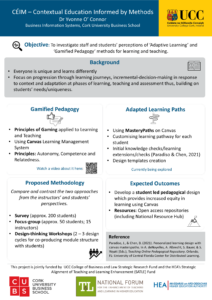
This poster offers educators an overview of designing a syllabus on the Canvas learning management system that supports personalised learning pathways. It highlights (1) a gamified pedagogy grounded in gaming principles and (2) adaptive learning strategies using MasteryPaths.
In 2018, the Glucksman Library at the University of Limerick launched Leganto, a reading list management tool designed to streamline access to academic resources for students. Leganto ensures equitable access to academic content, helping students engage with reliable sources and easing their transition into university-level study.
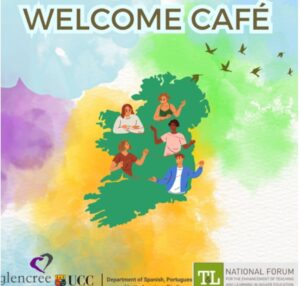
This toolkit draws on our experiences facilitating a SATLE-funded community-engaged learning project that brought students of the School of Languages, Literatures, and Cultures (UCC) together with people in Cork seeking international protection for a series of three wellbeing and creativity workshops.
The HEA Education for Sustainable Development Spotlight Series 2025: Case Studies Compendium brings together 115 case studies from higher education institutions across Ireland. It showcases how universities and colleges are integrating sustainability and the UN Sustainable Development Goals into teaching, research, curriculum design, assessment practices and community engagement. It offers a comprehensive picture of national ESD activity and provides an accessible resource for educators and policymakers seeking examples of practice-based innovation.