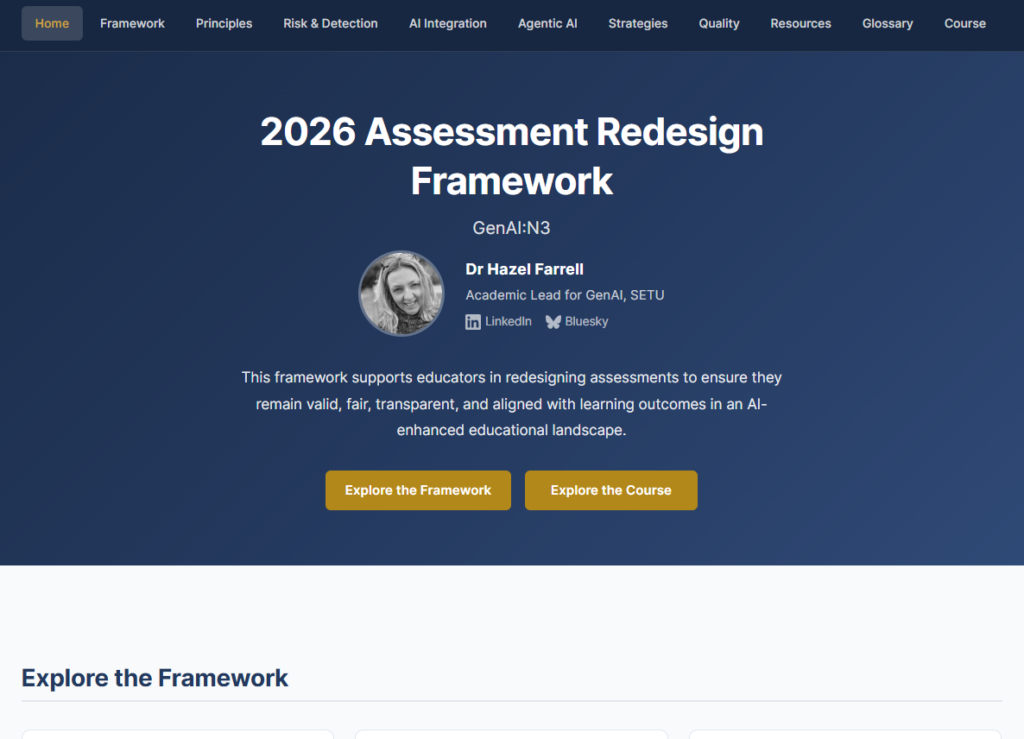
This OER presents an updated Assessment Redesign Framework for higher education in the age of GenAI. It supports educators and programme teams in designing valid, transparent, and scalable assessments, integrating AI literacy, process-focused approaches, and guidance on AI detection, large cohorts, and emerging agentic AI challenges.
Benefit of this resource and how to make the best use of it
This resource can be applied at module, programme, and institutional levels to support assessment redesign in AI-enhanced learning environments. Educators can use it to review existing assessments, introduce staged tasks, reflective elements, or oral components, and clarify expectations around AI use. Programme teams can apply it during curriculum review to balance AI-restricted and AI-integrated assessments and ensure alignment with learning outcomes and graduate attributes, including AI literacy.
Academic developers and instructional designers can integrate the framework into professional development workshops, curriculum design processes, and assessment policy discussions. It may also be adapted into checklists, templates, or review tools for programme validation, QA processes, and assessment mapping exercises, particularly in contexts involving large cohorts, anonymous marking, or evolving institutional AI guidelines.
This work is licensed under a CC BY-SA license, allowing adaptation and sharing with proper attribution, provided derivative works use the same license.
?
This citation is automatically generated and may require adjustment. Always verify it against your style guide.
Farrell, H. (09/02/2026). 2026 assessment redesign framework. National Resource Hub (Ireland). Retrieved from: https://hub.teachingandlearning.ie/resource/2026-assessment-redesign-framework/ License: Creative Commons Attribution-ShareAlike (CC BY-SA).
Adapting this resource? Share your version!
If you have modified or adopted this resource, share your version here. Tracking adaptations helps us measure impact and connects others with useful updates.
This OER guides students through human-in-the-loop software development, demonstrating how AI tools can be effectively supervised, refined, and integrated across the Software Lifecycle. Designed for computing educators and learners, it combines agile practice, teamwork, DISC awareness, testing, and critical reflection on human–AI collaboration.
This OER introduces students to designing and developing AI-powered assistants for agile software development using Flowise (no code). Learners as a team explore Retrieval Augmented Generation (RAG) and agent-based systems, applying AI to real-world agile practices while considering technical design, evaluation, and cost-aware decision-making
Through a thought-and-action mapping strategy known as interactive management, the current research modelled a unique, collaborative "pathway of impact influences" to describe such considerations from the perspectives of TUS higher management and external stakeholders.
This project presents an innovative engineering assessment framework integrating generative AI through a poster portfolio, AI reflection, and oral interview. It supports critical thinking, validation skills, and ethical AI use, and is designed for undergraduate engineering educators and students in project-based learning contexts.