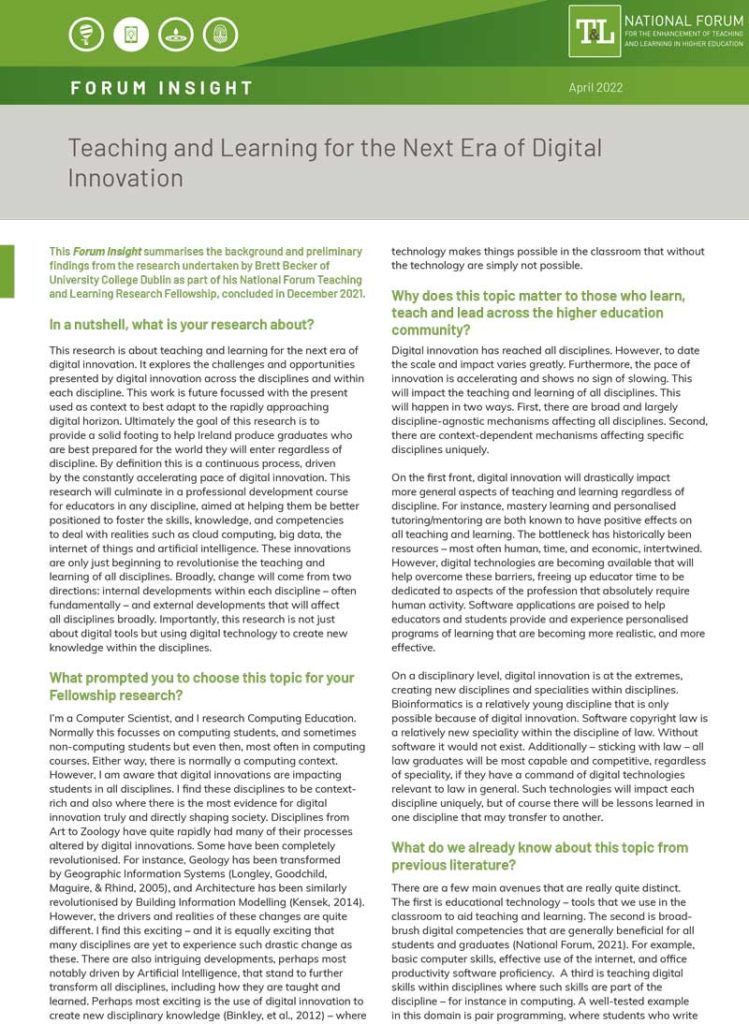
Teaching and Learning for the Next Era of Digital Innovation

[favorite_button]

Creator(s)

Brett Becker

Organisation(s)

National Forum

Discipline(s)

Education, Information and Communication Technologies, Teaching & Learning

Topic(s)

Digital World, National Forum Insights

License

CC BY

Media Format

PDF

Date Submitted

Submitted by

Export Resource Data

Description

Benefit of this resource and how to make the best use of it

This Forum Insight summarises the background and preliminary findings from the research undertaken by Brett Becker of University College Dublin as part of his National Forum Teaching and Learning Research Fellowship, concluded in December 2021.
Creative Commons Attribution (CC BY)

This work is licensed under a CC BY license, allowing sharing and adaptation with proper attribution.

https://creativecommons.org/licenses/by/4.0/
? This citation is automatically generated and may require adjustment. Always verify it against your style guide.
Becker, B. (2022). Teaching and learning for the next era of digital innovation. National Resource Hub (Ireland). Retrieved from: https://hub.teachingandlearning.ie/resource/teaching-and-learning-for-the-next-era-of-digital-innovation/ License: Creative Commons Attribution (CC BY).

Adapting this resource? Share your version!

If you have modified or adopted this resource, share your version here. Tracking adaptations helps us measure impact and connects others with useful updates.

Related OER

Recognizing the transformative potential of AI, the ICDE Quality Network has developed this report as a key initiative to explore its application in teaching and learning globally. This endeavour underscores the Network’s commitment to advancing quality education by promoting the responsible integration of AI.

Artificial Intelligence (AI) technologies and related automated decision-making processes are becoming increasingly embedded in the tissue of digital societies. Their impact cuts across different political, social, economic, cultural, and environmental aspects of our lives. On the one hand, AI can be used to drive economic growth, enable smart and low-carbon cities, and optimize the management of scarce resources such as food, water and energy. On the other hand, AI can also be used in a manner that infringes on human rights and fundamental freedoms, such as freedom of expression and privacy, and risks exacerbating existing socioeconomic and gender inequalities. Furthermore, the implementation of AI systems may lead to values-driven dilemmas and complex problems, often requiring trade-offs that can only be addressed through broad societal consensus.

This guide focuses on the question of how the development of AI policies can be made inclusive. Multistakeholder approaches to policymaking are part of the answer because they create the space for learning, deliberation, and the development of informed solutions. They help decision makers consider diverse viewpoints and expertise, prevent capture by vested interests, and counteract polarization of policy discourse. A multistakeholder approach to AI policy development and the consultation of stakeholders from different backgrounds and expertise are necessary to be able to develop a relevant and applicable policy for the national context.

The objective of this guide is to support policymakers in ministries and parliaments in the design and implementation of inclusive AI policies, while empowering stakeholders including civil society, businesses, technical community, academia, media, and citizens, to participate in and influence these policy processes

The report includes a ‘baseline’ of the challenges, practices and new developments during the pandemic, examples of research and innovation in online assessment, and the supportive (or non-supportive) national policies and frameworks that define the context of assessment for the institutions. It also includes practical examples (‘Good practices’) from SIG members that can help, if not inspire developing better practice and new thinking in other member institutions.