The barriers to peace in terrorist societies can seem senseless to outside observers, and students of psychology and social sciences aim to gain knowledge to understand why. We present a role play exercise in which students take the perspective of terrorists or landowners based on the N. Ireland conflict, to promote their understanding.
Benefit of this resource and how to make the best use of it
The barriers to peace in terrorist societies can seem senseless to outside observers. A role-play experiment in which students take the perspective of terrorists or landowners based on the N. Ireland conflict is presented. We found this exercise is highly engaging and memorable for students of psychology and social sciences. We recommend its use across the range of social psychology and socio-cultural courses.
Pretext: Students are asked to be either a Plutat (Protestant) or a Camta (Catholic). They each knew that both imaginary societies used bombing and assassination strategies, and that three thousand people had been killed on both sides. Repeat observations of this exercise finds that blame is first apportioned equally, both cease military offensives together, and a map sharing the land equally is chosen. After receiving an envelope containing information randomly labelling one society as ‘landowners’ and the other as ‘terrorists’ they each invariably start to blame one another, expect the other to ceasefire first, and the ‘landowners’ refuse to share the land equally with their ‘terrorist’ counterparts. This role play exercise is relevant for students learning to understand social behaviour in contemporary society, and confirms that perspective taking cannot presuppose that positive rather than negative representations of another will be activated (Epley et al., 2006).
Creative Commons Attribution (CC BY)
This work is licensed under a CC BY license, allowing sharing and adaptation with proper attribution.
?
This citation is automatically generated and may require adjustment. Always verify it against your style guide.
Gregg, A., & Cowley-Cunningham, M. (2023). Perspective-taking in an imaginary society: asymmetric expectations (an us and them roleplay exercise). National Resource Hub (Ireland). Retrieved from: https://hub.teachingandlearning.ie/resource/perspective-taking-in-an-imaginary-society-asymmetric-expectations-an-us-and-them-roleplay-exercise/ License: Creative Commons Attribution (CC BY).
Adapting this resource? Share your version!
If you have modified or adopted this resource, share your version here. Tracking adaptations helps us measure impact and connects others with useful updates.
This is an interactive multimedia open educational resource (OER), created using H5P, on the topic of Open Education. It has been developed by the Department of Technology Enhanced Learning at Munster Technological University.
The purpose of which is to give an overview of OEPs, using interactive features of H5P
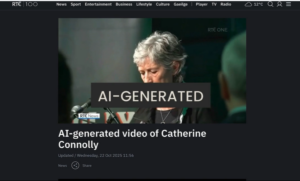
A video that discusses how Artificial Intelligence is impacting the way disinformation is created and spread to manipulate public opinion. It also outlines importance of Media Literacy education and regulatory measures, referencing Ireland’s Online Safety and Media Regulation Act and the EU’s Digital Services Act.
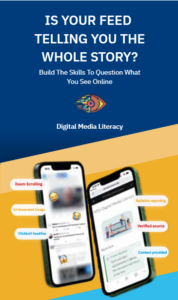
This interactive online resource is a set of eight units to support learners in their online information ecosystem. It is a mix of text, images, video, audio and interactive tasks. The resource can be accessed directly via the link provided or embedded in any Learning Management System compatible with SCORM files.
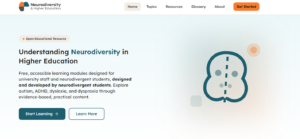
An open educational resource that supports academic, professional, and support staff to build more neuro-inclusive teaching, services, and policies in higher education. This resource was conceptualised & developed through the experiences of neurodivergent students in third-level education, with co-creation at the heart of every stage of the process