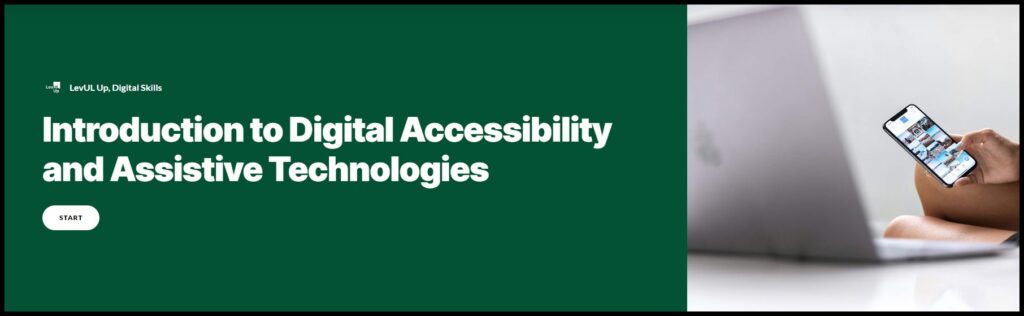
Introduction to Digital Accessibility and Assistive Technologies

[favorite_button]

Creator(s)

David Moloney, Thomas O'Shaughnessy, William Nolan, Yvonne Hynes

Organisation(s)

Centre for Transformative Learning, Digital Skills, Educational Assistive Technology Centre, Student Affairs, University of Limerick

Discipline(s)

Information and Communication Technologies, Teaching & Learning

Topic(s)

Accessibility and Inclusion, Digital Learning, Student Success

License

CC BY-NC-SA

Media Format

Website

Date Submitted

Submitted by

Export Resource Data

Description

A 45-minute comprehensive foundational lesson on digital accessibility principles, inclusive content creation, and available assistive technologies at university level. Collaboration with Educational Assistive Technology Centre, UL, launched for Global Accessibility Awareness Day. The primary intended audience is students.
Benefit of this resource and how to make the best use of it

Creative Commons Attribution-NonCommercial-ShareAlike (CC BY-NC-SA)

This work is licensed under a CC BY-NC-SA license, allowing sharing and adaptation for non-commercial use with proper attribution, provided derivative works use the same license.

https://creativecommons.org/licenses/by-nc-sa/4.0/
? This citation is automatically generated and may require adjustment. Always verify it against your style guide.
Moloney, D., O'Shaughnessy, T., Nolan, W., & Hynes, Y. (01/05/2024). Introduction to digital accessibility and assistive technologies. National Resource Hub (Ireland). Retrieved from: https://hub.teachingandlearning.ie/resource/introduction-to-digital-accessibility-and-assistive-technologies/ License: Creative Commons Attribution-NonCommercial-ShareAlike (CC BY-NC-SA).

Adapting this resource? Share your version!

If you have modified or adopted this resource, share your version here. Tracking adaptations helps us measure impact and connects others with useful updates.

Related OER

A self-paced resource introducing Articulate Rise 360, an authoring tool for creating interactive, mobile-responsive e-learning content. Covers content design principles, interaction types, accessibility features, and publishing workflows. Designed primarily for instructional designers, educators, and professionals new to Rise.

A self-study resource addressing healthy relationships with digital technology, addressing digital addiction, privacy concerns, work-life balance, and digital identity management. Includes scenarios exploring real wellbeing challenges. Emphasises positive and negative impacts of digital participation. The primary audience is university students.