An open-source capability framework for higher education. 4 dimensions, 16 domains and 70+ capabilities.
Benefit of this resource and how to make the best use of it
In 2018, HolonIQ released an open source 16-point framework identifying key capabilities underpinning digital higher education. The 16-point framework was used by institutions in different ways to articulate, share and showcase current and emerging models in digital learning, and to identify areas for strategic focus and development.
The 2020 Higher Education Digital Capability (HEDC) Framework builds on the earlier model and adds a deeper focus on digital capabilities across the whole learner lifecycle. Institutional capabilities have been mapped to four connected dimensions across the lifecycle, from Demand & Discovery (DD) to Learning Design (LD), Learner Experience (LX) and Work & Lifelong Learning (WL). The framework encompasses current capabilities such as recruitment, curriculum design, assessment and career planning, but also looks ahead to future and emerging capabilities for successful digital learning. Informed by academic research and with input from higher education leaders globally, the HEDC Framework offers an overarching view for institutions to map and measure digital capabilities across the learner lifecycle, ultimately to support practical and sustainable approaches to digital services and online learning.
Creative Commons Attribution (CC BY)
This work is licensed under a CC BY license, allowing sharing and adaptation with proper attribution.
?
This citation is automatically generated and may require adjustment. Always verify it against your style guide.
HolonIQ (2021). Higher education digital capability framework. National Resource Hub (Ireland). Retrieved from: https://hub.teachingandlearning.ie/resource/higher-education-digital-capability-framework/ License: Creative Commons Attribution (CC BY).
Adapting this resource? Share your version!
If you have modified or adopted this resource, share your version here. Tracking adaptations helps us measure impact and connects others with useful updates.
This is an interactive multimedia open educational resource (OER), created using H5P, on the topic of Open Education. It has been developed by the Department of Technology Enhanced Learning at Munster Technological University.
The purpose of which is to give an overview of OEPs, using interactive features of H5P
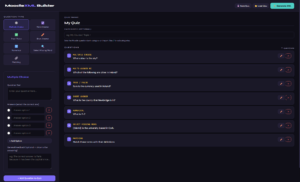
The purpose of this resource is to allow Moodle teachers to quickly create quizzes for Moodle. Users can quickly select between questions types through a single interface and export their questions as an XML file which can be imported into Moodle.
Conor Moynihan, Senior Engineer John Sisk & Sons. Structural Engineering @MTU Alumnus. In this video we meet Conor who graduated from MTU and is now a senior Engineer with Sisks in the UK.