CÉIM – Contextual Education Informed by Methods

[favorite_button]

Creator(s) (alphabetical)

Yvonne OConnor

Organisation(s)

University College Cork

Discipline(s)

Administration and Law, Business, Information and Communication Technologies

Topic(s)

Curriculum Design, Digital Learning, Student Success

License

CC BY-SA

Media Format

PDF

Date Submitted

Submitted by

Export Resource Data

Description

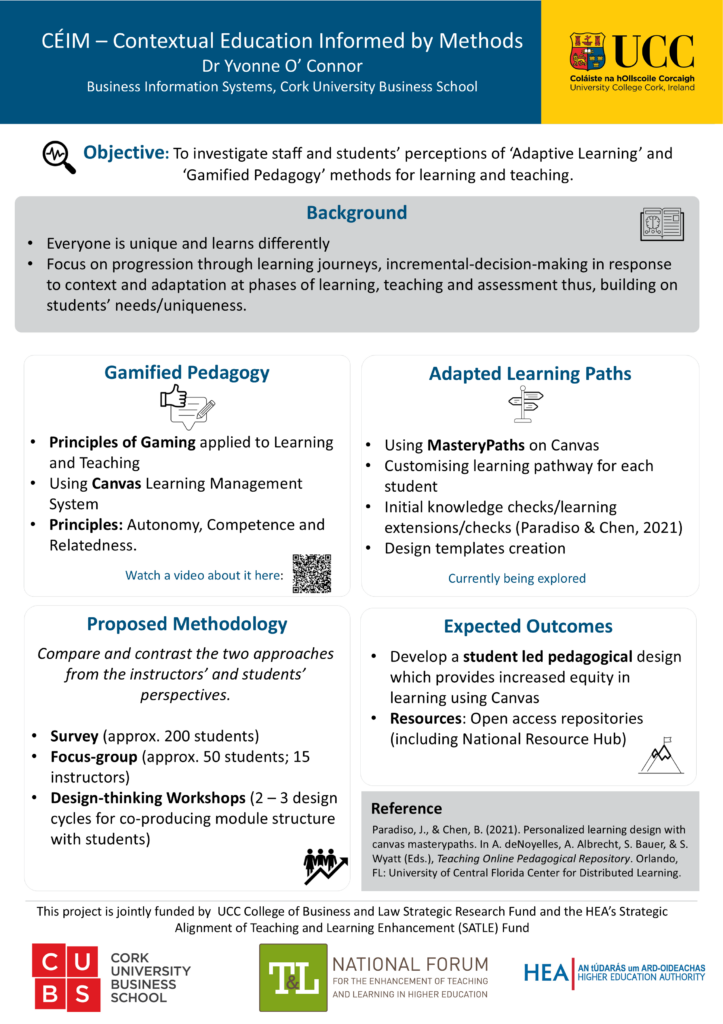
This poster offers educators an overview of designing a syllabus on the Canvas learning management system that supports personalised learning pathways. It highlights (1) a gamified pedagogy grounded in gaming principles and (2) adaptive learning strategies using MasteryPaths.

Benefit of this resource and how to make the best use of it

While the poster presents research in progress, a QR code links to a video demonstrating the implementation of the gamified approach on Canvas. The approach follows the gaming principles of autonomy, competence, and relatedness, with the video shown from a student perspective. The video highlights approaches that educators can embed within their practice to increase student engagement and learning satisfaction.

Creative Commons Attribution-ShareAlike (CC BY-SA)

This work is licensed under a CC BY-SA license, allowing adaptation and sharing with proper attribution, provided derivative works use the same license.

https://creativecommons.org/licenses/by-sa/4.0/
? This citation is automatically generated and may require adjustment. Always verify it against your style guide.
OConnor, Y. (21/11/2025). Céim – contextual education informed by methods. National Resource Hub (Ireland). Retrieved from: https://hub.teachingandlearning.ie/resource/ceim-contextual-education-informed-by-methods/ License: Creative Commons Attribution-ShareAlike (CC BY-SA).

Adapting this resource? Share your version!

If you have modified or adopted this resource, share your version here. Tracking adaptations helps us measure impact and connects others with useful updates.

Related OER

Slides for a digital wellbeing workshop that enables effective navigation of the digital world by
– exploring research on problematic internet use,
– offers workshop participants an opportunity to reflect on their own technology use
– uses the science of habits and the tiny habits methodology to promote more mindful use of digital technology

In this 360 immersive video, Dr Mary Moloney – head of the Department of Civil, Structural and Environmental Engineering at Munster Technological University – gives a guided tour of the "Red Shed" at Cork City's Marina Park. Dr Moloney highlights key structural features.