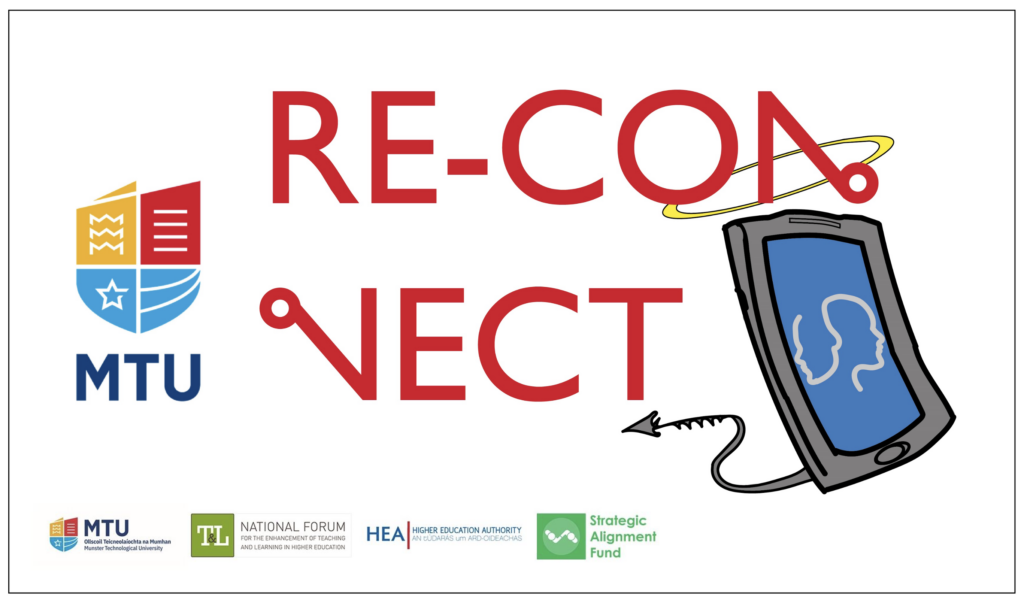
Digital Wellbeing – Reconnect a workshop to promote mindful technology use

[favorite_button]

Creator(s) (alphabetical)

Catherine Murphy, Oonagh O'Brien

Organisation(s)

Munster Technological University

Discipline(s)

Health and Welfare

Topic(s)

Digital Learning, Education for Sustainable Development (ESD), Other

License

CC BY-ND

Media Format

Date Submitted

Submitted by

Export Resource Data

Description

Slides for a digital wellbeing workshop that enables effective navigation of the digital world by
– exploring research on problematic internet use,
– offers workshop participants an opportunity to reflect on their own technology use
– uses the science of habits and the tiny habits methodology to promote more mindful use of digital technology
Benefit of this resource and how to make the best use of it

Developing awareness of the research findings on the the links between wellbeing and loneliness and overuse of technology for distraction, supporting peer group reflection and consideration of the science of habits enables participants in this workshop to make more concious decisions on how they use digital technology that aligns were their goals and values and thus improve academic performance and wellbeing.

Creative Commons Attribution-NoDerivatives (CC BY-ND)

This work is licensed under a CC BY-ND license, allowing redistribution with proper attribution but prohibiting derivative works.

https://creativecommons.org/licenses/by-nd/4.0/
? This citation is automatically generated and may require adjustment. Always verify it against your style guide.
Murphy, C., & O'Brien, O. (01/02/2020). Digital wellbeing – reconnect a workshop to promote mindful technology use. National Resource Hub (Ireland). Retrieved from: https://hub.teachingandlearning.ie/resource/digital-wellbeing-reconnect-a-workshop-to-promote-mindful-technology-use/ License: Creative Commons Attribution-NoDerivatives (CC BY-ND).

Adapting this resource? Share your version!

If you have modified or adopted this resource, share your version here. Tracking adaptations helps us measure impact and connects others with useful updates.

Related OER

This OER explores novice programmers’ experiences of pair programming across face-to-face, hybrid, and remote settings. It provides insights into collaboration, role switching, satisfaction, and challenges, helping educators and students understand how to effectively prepare learners for modern hybrid software development environments.

This OER guides students through human-in-the-loop software development, demonstrating how AI tools can be effectively supervised, refined, and integrated across the Software Lifecycle. Designed for computing educators and learners, it combines agile practice, teamwork, DISC awareness, testing, and critical reflection on human–AI collaboration.

This OER introduces students to designing and developing AI-powered assistants for agile software development using Flowise (no code). Learners as a team explore Retrieval Augmented Generation (RAG) and agent-based systems, applying AI to real-world agile practices while considering technical design, evaluation, and cost-aware decision-making