higher education

Sort by

Filter by

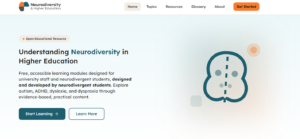
An open educational resource that supports academic, professional, and support staff to build more neuro-inclusive teaching, services, and policies in higher education. This resource was conceptualised & developed through the experiences of neurodivergent students in third-level education, with co-creation at the heart of every stage of the process

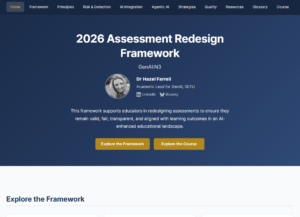
This OER presents an updated Assessment Redesign Framework for higher education in the age of GenAI. It supports educators and programme teams in designing valid, transparent, and scalable assessments, integrating AI literacy, process-focused approaches, and guidance on AI detection, large cohorts, and emerging agentic AI challenges.

This Podcast Series has been developed by CPID Staff involved in teaching and engaging in educational research. It consists of podcasts with well-known educational academics and experts, exploring various educational concepts/topics taught on programmes offered by the CPID, and on SATLE funded educational research projects.

This landscape report provides an overview of Education for Sustainable Development (ESD) practice across the higher education sector in Ireland. It draws together publicly available institutional strategies, HEA Performance Framework Agreements 2024–2028, Climate Action Roadmaps and ESD to 2030 progress reports to outline current approaches to embedding ESD.

Structured as a series of institutional case studies, the report highlights how ESD is being addressed across teaching and learning, research, engagement and whole-institution practice, and identifies opportunities for collaboration and shared learning across the sector.

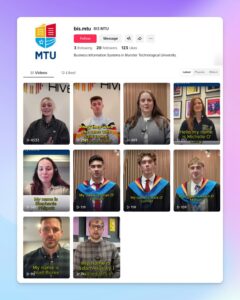
Short-form video interviews with MTU Business Information Systems graduates showcasing diverse career paths, designed to support professional identity development. These TikTok-style exemplars help students connect personal values with authentic career journeys, achieving 62,539+ views across social media platforms.

This report presents findings from the HEA Student Success Survey 2025, capturing how students across Ireland define, experience and achieve success in higher education. Based on responses from over 3,400 students across publicly funded higher education institutions, it provides a national, student-centred perspective on success.

The report explores students’ definitions of success, the supports and enablers that help them thrive, and the barriers that can hinder progress. It highlights the relational and holistic nature of student success, encompassing academic achievement alongside well-being, belonging, personal growth and future readiness.

The HEA Education for Sustainable Development Spotlight Series 2025: Case Studies Compendium brings together 115 case studies from higher education institutions across Ireland. It showcases how universities and colleges are integrating sustainability and the UN Sustainable Development Goals into teaching, research, curriculum design, assessment practices and community engagement. It offers a comprehensive picture of national ESD activity and provides an accessible resource for educators and policymakers seeking examples of practice-based innovation.

A collection of case studies of evidence-informed interventions implemented by higher education institutions in Ireland to support student retention and progression across the undergraduate lifecycle. These exemplars are presented here as a national evidence base of student progression initiatives.

The Manifesto for Generative AI in Higher Education is a living resource for educators, students, and institutions. It invites reflection and dialogue across thirty statements exploring teaching, ethics, and imagination – helping higher education navigate AI with curiosity, integrity, and humanity.

These presentation slides, created and delivered by Dr Alex Ryan (Learning Energy) for the Advancing Quality and Leadership in Sustainable Higher Education workshop hosted by the Higher Education Authority (HEA), introduce the principles and practice of Anti-Greenwash Education within the context of Education for Sustainable Development (ESD).

The slides outline findings from the QAA-funded project Students Driving Curriculum Quality for Sustainability and provide a visual summary of how student-led approaches can strengthen transparency, quality, and credibility in sustainability education. They include key concepts, activity prompts, examples of course evaluation frameworks, and student feedback on applying ESD quality principles.

The workshop offered a structured overview of how institutions can embed authentic, evidence-based ESD across courses and policies, connecting workshop learning to wider sector priorities and the Government of Ireland’s ESD to 2030 Strategy.

This curated collection includes key materials, toolkits, and reports from the Anti-Greenwash Education initiative, developed to support quality, transparency, and integrity in Education for Sustainable Development (ESD). It provides direct access to the education kit, training resources, worked examples, film series, sector review, and action guidance, along with related reports and international frameworks informing current ESD policy and practice.

The resource is designed for students, course representatives, and staff engaged in sustainability education and quality enhancement. It connects practical learning tools with wider evidence on ESD trends, student demand for sustainability, and institutional quality frameworks, offering an overview of current developments in the field.

This resource was shared as part of the Advancing Quality and Leadership in Sustainable Higher Education workshop hosted by the Higher Education Authority (HEA) and facilitated by Dr Alex Ryan. The workshop supported Irish higher education institutions in strategically implementing high-quality ESD in alignment with the Government of Ireland’s ESD to 2030 Strategy and the HEA’s ESD programme objectives.

This resource presents AVINA, an automated visual novel generator using large language models to transform multiple-choice questions into interactive learning narratives. Designed for educators and students, it supports gamified training in academic integrity and ethical decision-making through adaptive storytelling and experiential learning.

The report – Generative AI in Higher Education Teaching and Learning: Sectoral Perspectives – was commissioned as part of the Higher Education Authority’s evidence-led approach to policy development.

The report captures the views of staff, students, and leaders across the Irish higher education system on the opportunities and challenges posed by artificial intelligence.

It brings together insights from ten thematic focus groups and a leadership summit, involving over 80 participants from across Ireland’s higher education institutions, alongside student representatives and sectoral stakeholders.

This resource portal is dedicated to providing centralised access to policies, guidelines, and resources for teaching and learning in higher education in the context of generative artificial intelligence. The curated policies and frameworks offer authoritative guidance and practical support to inform and enhance institutional practice.

The VISIEN Framework Document is a strategic guide for integrating immersive technologies (AR, VR, MR, XR) into higher education. It offers practical guidance on curriculum integration, accessibility, collaboration, skill development, institutional readiness, and more to support transformative teaching, learning, and research.

The course is targeted at senior leaders to support the implementation of universal design and the adoption of the national ALTITUDE Charter https://www.mtu.ie/universal-design/ and aims to complement the existing Digital Badge for Universal Design in Teaching & Learning https://www.ahead.ie/udl-digital-badge and the Digital Badge Universal Design Beyond the Classroom https://www.ahead.ie/journal/Launch-Universal-Design-Beyond-the-Classroom-Digital-Course-and-Digital-Badge

Transition from Further Education and Training to Higher Education

The National Forum, in partnership with the Further Education and Training (FET) sector, conducted a survey and interviews in 2016 of FET learners’ experiences of transition to higher education. A Forum Insight on Transition from Further Education and Training to Higher Education can be accessed here.