PDF

Sort by

Filter by

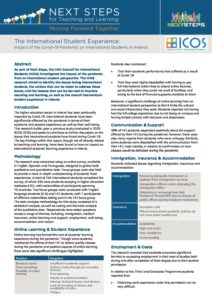
As part of Next Steps, the Irish Council for International Students (ICOS) investigated the impact of the pandemic from an international student perspective. The ICOS research aimed to identify the issues facing international students, the actions that can be taken to address these issues, and the lessons that can be learned to improve teaching and learning, as well as the overall international student experience in Ireland.

42 participants from student and core stakeholder groups
supporting teaching and learning across seven member
institutions of the Irish Universities Association (IUA) took
part in six focus group sessions in June 2021. The aim was to
capture the “lived experience” of the Covid-19 situation, how
changes in practice brought about by lockdown are being
embedded into mainstream practice, and key lessons for moving
forward. This Insight outlines common themes that emerged
across all the groups and identifies emerging areas for greater
inter-institutional collaboration, while recognising that this is a
snapshot of contextualised experiences shared and highlighted
by the groups in June 2021.

Ibec is Ireland’s largest business lobby and representative group, with our members employing over 70% of private sector workers. We believe the cornerstone of Ireland’s social and economic success is a strong pipeline of talent supported by a world class education system. Ibec’s contribution to the Next Steps project is understanding the impact of Covid-19 on the future of work and what this means for teaching and learning.

The Higher Education Colleges Association (HECA) established in 1991, is the representative body for thirteen established and state accredited privately funded providers of higher education. All HECA members have quality assurance approval under Quality & Qualifications Ireland (QQI) and deliver QQI validated programmes across a diverse range of disciplines, between levels 6 and 9 on the National Framework of Qualifications. The student body within the HECA network of college providers is over 27,000.

HECA member higher education providers advance the highest standards of best practice, evidence-based teaching and learning. Learner-centred teaching is at the heart of the mission of each of HECA’s member institutions. HECA providers have a shared strategic priority to continue to invest and enhance its teaching to a sector-leading standard. This core function, together with innovative and diverse assessment strategies, combine in a transformative process of education for the learner, building knowledge, skill and competence through state accredited programme curricula. The opportunity to participate as partner in the Next Steps project further solidifies HECA’s position as a collective united by a desire to connect, support and inform all those involved in the enhancement of teaching and learning in HECA colleges.

This recommendation approaches AI ethics as a systematic normative reflection, based on a holistic, comprehensive, multicultural and evolving framework of interdependent values, principles and actions that can guide societies in dealing responsibly with the known and unknown impacts of AI technologies on human beings, societies and the environment and ecosystems, and offers them a basis to accept or reject AI technologies. It considers ethics as a dynamic basis for the normative evaluation and guidance of AI technologies, referring to human dignity, well-being and the prevention of harm as a compass and as rooted in the ethics of science and technology.

Despite the pandemic presenting a myriad of challenges and difficulties, many innovative practices, processes and actions have been developed to address the extraordinary circumstances. This unprecedented crisis has inadvertently demonstrated the flexibility and capability of much of the sector that can be harnessed to improve the experiences of students with disabilities in future learning.

Since March 2020 higher education has experienced one of the most disruptive phases in its recent history. In a sector typified by considered, researched and incremental change, overnight everyone began emergency remote teaching, learning and assessing. The dramatic shift resulted in positives and negatives, and posed a series of questions for students, staff and other stakeholders. Though still living through the pandemic, in March 2021 fifteen partners from a range of stakeholders across the sector agreed to work together to answer one shared persistent and urgent question: In the context of Covid-19, what have we learnt and what does it mean for the future of teaching and learning in Irish higher education?

This infographic is derived from the National Forum Open Licensing Toolkit, a document that outlines the National Forum’s commitment to open licensing, which enables the creation and sharing of open…
How to Choose an Open Licence is an infographic based on a guide of the same name published in the National Forum OER/OEP Series: Open Educational Resources and Open Educational…

OpenGame project (Promoting Open Education through Gamification) aims to contribute to the uptake of Open Education Resources and Open Education Practices among educators in Higher Education in an innovative and motivating way, through the developing of a gamified and situated learning experience on Open Education. It is a project funded by the Erasmus+ Programme of the European Commission. The main objectives of the project are:

1. Foster awareness of HE educators to adopt OEP in their daily teaching, by mainstreaming successful practices.
2. 2 Increase motivation of HE educators towards adopting OEP by providing an attractive and motivating environment.
3. 3 Develop capacity of HE educators to work with open approaches, through an engaging gamified learning experience

All the results of OpenGame Project can be found here: www.opengame-project.eu/results/

This resource can be used as part of an individual’s engagement with the PD Framework for all who teach in Higher Education. It can be used to reflect on professional…
This resource can be used as part of an individual’s engagement with the PD Framework for all who teach in Higher Education. It is especially useful for gathering evidence in…
INDEx Survey: Final Summary Report

This INDEx Survey Final Summary Report outlines how INDEx Survey findings provided a source of evidence for the initial response to the COVID crisis, have supported data-informed decision-making in multiple ways, and represent an important baseline of pre-COVID teaching, learning and digital experience.

Guiding Framework for Embedding Student Success
The National Forum has developed this one-page guiding framework to inform conversations at institutional level in the development of approaches to embedding student success. The framework identifies three key pillars…