

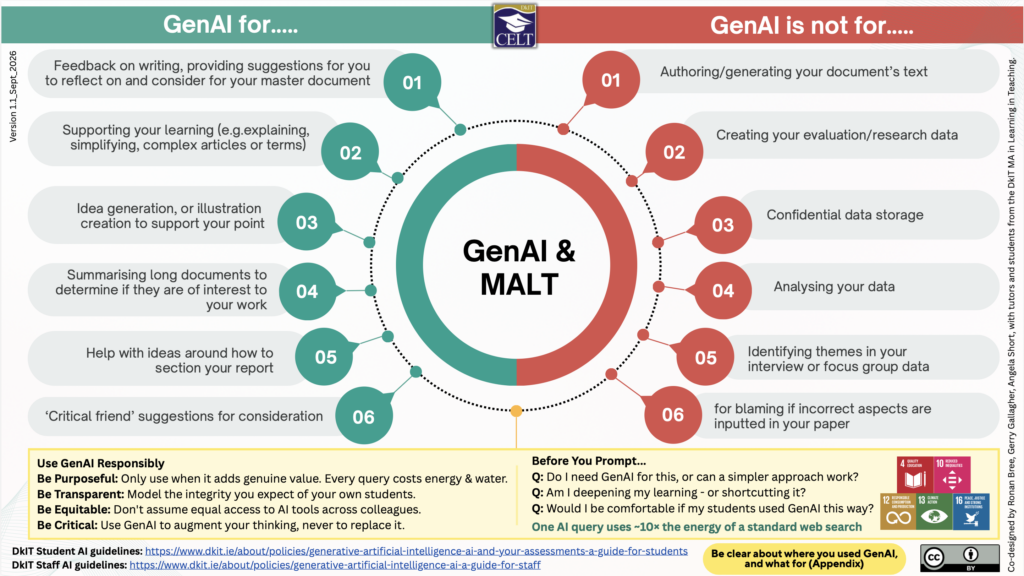
A 1-page guide, co-created by lecturers, tutors & students on DkIT's MA in Learning and Teaching, showing where GenAI can, and can't, support particular postgraduate research/skill development (*reflecting practice 2025-26). Includes student-informed prompts on responsible, sustainable use. An editable PowerPoint supports adaptation to own context.
Benefit of this resource and how to make the best use of it
This resource gives students a clear, visual starting point for thinking about where GenAI can support their learning and where it risks undermining the skills our particular programme team has decided to protect and/or develop. Because it was co-created with lecturers, tutors and students, it reflects real concerns and questions raised in modules. The guide also models a collaborative approach that other programmes can replicate, or adapt to their context and needs.
The editable PowerPoint included is designed to facilitate adaptation. Programme teams can revise the “GenAI for…” and “GenAI is not for…” columns to suit their discipline and assessment types. For example, a team might tailor them to lab reports, design portfolios or reflective journals. Links to DkIT policies can be replaced with local institutional guidance, and the disclosure prompt can be aligned with a programme’s own AI declaration requirements.
Educators may use it as a discussion stimulus in induction or early-semester sessions, inviting students to challenge and add to each column before agreeing a local version together. Academic developers could use it in staff workshops on assessment design, asking participants to map it against their own module learning outcomes. Instructional designers could embed an adapted version in VLE module pages alongside assessment briefs, so guidance is visible at the point of need.
Given how quickly GenAI is evolving, we recommend treating the guide as a living document and revisiting it each semester with both staff and students.
Creative Commons Attribution (CC BY)
This work is licensed under a CC BY license, allowing sharing and adaptation with proper attribution.
?
This citation is automatically generated and may require adjustment. Always verify it against your style guide.
Short, A., Gallagher, G., Students, M., Tutors, M., & Bree, R. (13/02/2026). Genai use guidance for a masters programme in dkit. National Resource Hub (Ireland). Retrieved from: https://hub.teachingandlearning.ie/resource/genai-use-guidance-for-a-masters-programme-in-dkit/ License: Creative Commons Attribution (CC BY).
Adapting this resource? Share your version!
If you have modified or adopted this resource, share your version here. Tracking adaptations helps us measure impact and connects others with useful updates.
MTU researchers, together with national and international researchers, presented local, national, and global insights into the challenges and opportunities of assessment and feedback in work placement settings.
This book is designed specifically for students studying at the Technological University of the Shannon – Midlands Midwest, Ireland. It presents a step-by-step practical guide to academic writing, referencing and presentation, with clear explanations and structured approaches with examples that support the development of clear and concise writing.
Teaching and Assessment for Learning Checklists aimed at early career & seasoned lecturers. The checklists provide guidance & reliable curated resources for lecturers who want to deliver an engaging and positive learning experience for their students. They act as a guide to check existing approaches, and help analyse how improvements can be made.
Team Tool is an open educational resource (OER) designed to support equitable,
e ective teamwork in higher education. It was developed in response to persistent
challenges in collaborative work, including uneven contribution, lack of
accountability and student dislike and anxiety around group projects.