

Neurodiversity and Third Level Education: A Reusable Learning Resource

[favorite_button]

Creator(s) (alphabetical)

Etain Quigley

Organisation(s)

Centre of Teaching and Learning, Maynooth University, School of Law and Criminology

Discipline(s)

Education, Teaching & Learning

Topic(s)

Accessibility and Inclusion, Open Education

License

CC BY-NC-SA

Media Format

Website

Date Submitted

Submitted by

Export Resource Data

Description

An open educational resource that supports academic, professional, and support staff to build more neuro-inclusive teaching, services, and policies in higher education. This resource was conceptualised & developed through the experiences of neurodivergent students in third-level education, with co-creation at the heart of every stage of the process
Benefit of this resource and how to make the best use of it

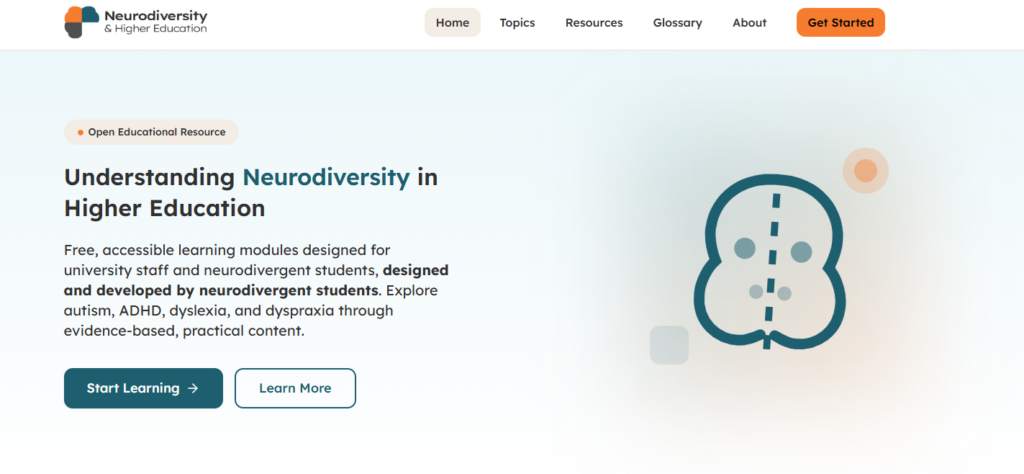
Free, accessible learning modules designed for university staff and neurodivergent students, designed and developed by neurodivergent students. Explore autism, ADHD, dyslexia, and dyspraxia through evidence-based, practical content.

Creative Commons Attribution-NonCommercial-ShareAlike (CC BY-NC-SA)

This work is licensed under a CC BY-NC-SA license, allowing sharing and adaptation for non-commercial use with proper attribution, provided derivative works use the same license.

https://creativecommons.org/licenses/by-nc-sa/4.0/
? This citation is automatically generated and may require adjustment. Always verify it against your style guide.
Quigley, E. (25/02/2026). Neurodiversity and third level education: a reusable learning resource. National Resource Hub (Ireland). Retrieved from: https://hub.teachingandlearning.ie/resource/neurodiversity-and-third-level-education-a-reusable-learning-resource/ License: Creative Commons Attribution-NonCommercial-ShareAlike (CC BY-NC-SA).

Adapting this resource? Share your version!

If you have modified or adopted this resource, share your version here. Tracking adaptations helps us measure impact and connects others with useful updates.

Related OER

Enhancing Student Engagement and Belonging through Collaborative Partnership is a Higher Education Authority report prepared by a UCD research team led by Professor Barbara Dooley. The resource provides an evidence-informed framework for strengthening student belonging across Irish higher education institutions. Drawing on staff interviews, Healthy Campus survey responses, and analysis of Healthy Campus and NStEP case studies, it identifies practical approaches to improving student engagement, wellbeing and inclusion.

The report frames belonging as a multidimensional and co-constructed experience shaped by social, academic, personal and environmental factors. It highlights that student belonging is affected not only by relationships and participation, but also by structural issues such as housing, commuting, financial pressure, campus spaces, timetable design and access to supports.

The resource is particularly useful for staff and student partners working on Healthy Campus, student success, student engagement, access, inclusion, mental health promotion, orientation, peer support, student partnership and campus development initiatives.

In this video Ciarán O’Connor for the Institute of Strategic Dialogue guides us through a case study of how false information was used to undermine confidence in the Irish local elections in June 2024.

Project NOURISH is a campus-based nutrition and health intervention, originally designed for MTU staff. This was designed as part of a broader research study to investigate how to enable healthier dietary behaviours within university environments.

In today’s digital age, information spreads fast—yet not all of it is true or trustworthy. Knowing the differences between misinformation, disinformation, and malinformation is key to thinking critically online.
In the video below Ciarán O’Connor from the Institute of Strategic Dialogue discusses the disinformation ecosystem in Ireland.