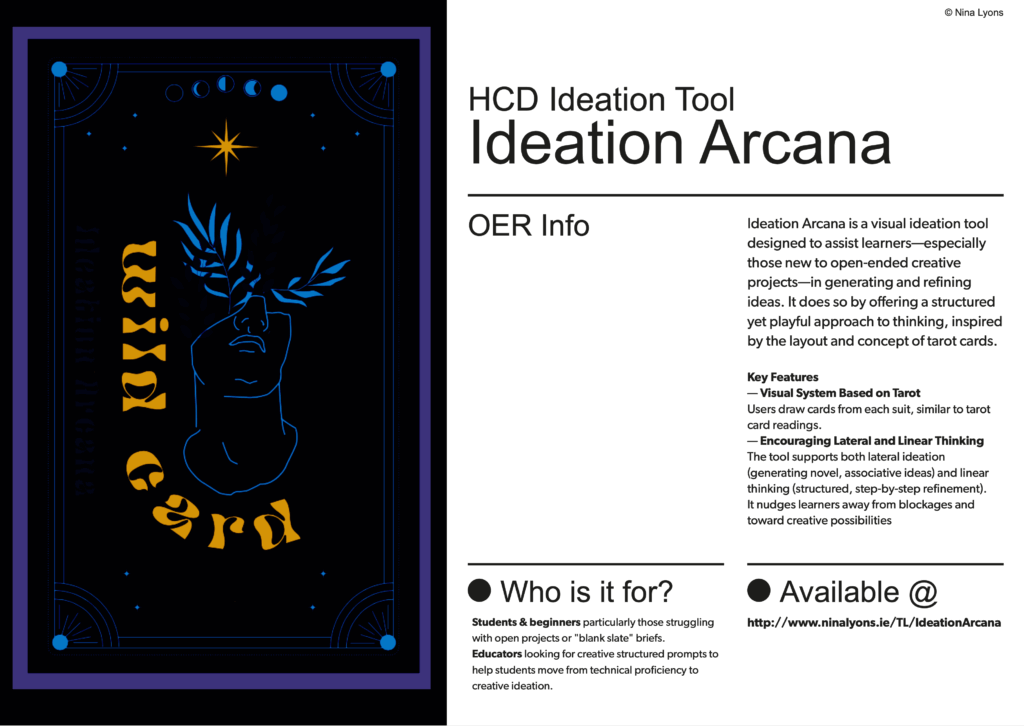
Ideation Arcana is a visual ideation tool designed to assist learners—especially those new to open-ended creative projects—in generating and refining ideas. It does so by offering a structured yet playful approach to thinking, inspired by the layout and concept of tarot cards.
Benefit of this resource and how to make the best use of it
Discover Ideation Arcana: a playful and meaningful ideation tool inspired by tarot-card rituals. Draw cards to explore everyday moments—your commute, interactions, routines—and use them to inspire new ideas. Layer in constraints and visual prompts to challenge your thinking and imagine projects that are unexpected yet rooted in real life. Think of it as a reflective catalyst—visual, structured, and designed to spark curiosity and insight.
Key Concepts & Mechanics
1. Visual System Based on Tarot
Users draw cards from each suit, similar to tarot card readings. Each card guides the user with prompts or questions related to different aspects of their life—like their daily routines, commuting experiences, or interactions with others.
2. Framing Context & Perspective
Once cards are drawn and laid out, they can be “read” together.
The reading helps frame a situation in context, prompting users to observe, question, and empathize with their environment and social interactions.
3. Encouraging Lateral and Linear Thinking
The tool supports both lateral ideation (generating novel, associative ideas) and linear thinking (structured, step-by-step refinement).
It nudges learners away from blockages and toward creative possibilities.
Who Is This Tool For?
Students: particularly those struggling with open projects or “blank slate” briefs.
Educators: looking for creative structured prompts to help students move from technical proficiency to creative ideation.
Why It Matters
— Addresses a common challenge: “Where do I even begin?”
— This tool adds playfulness, structure, and depth to the ideation process.
— Encourages empathic, reflective design, grounded in real life experiences.
— Offers a tangible, card-based interface for something as abstract as creativity.

Creative Commons Attribution (CC BY)
This work is licensed under a CC BY license, allowing sharing and adaptation with proper attribution.
If you have modified or adopted this resource, share your version here. Tracking adaptations helps us measure impact and connects others with useful updates.
This OER presents findings from a comparative study of novice programmers engaging in face-to-face and hybrid pair programming. It explores collaboration patterns, role switching, satisfaction, and challenges, offering evidence-based insights for educators seeking to prepare students for effective teamwork in modern hybrid software development.
This OER explores novice programmers’ experiences of pair programming across face-to-face, hybrid, and remote settings. It provides insights into collaboration, role switching, satisfaction, and challenges, helping educators and students understand how to effectively prepare learners for modern hybrid software development environments.
This OER guides students through human-in-the-loop software development, demonstrating how AI tools can be effectively supervised, refined, and integrated across the Software Lifecycle. Designed for computing educators and learners, it combines agile practice, teamwork, DISC awareness, testing, and critical reflection on human–AI collaboration.
This OER introduces students to designing and developing AI-powered assistants for agile software development using Flowise (no code). Learners as a team explore Retrieval Augmented Generation (RAG) and agent-based systems, applying AI to real-world agile practices while considering technical design, evaluation, and cost-aware decision-making