A. Hickey, C. O’Faolain and P. Cuffe, “Large Language Models in Power Engineering Education: A Case Study on Solving Optimal Dispatch Coursework Problems”, presented at IEEE International Conference on IT in Higher Education and Training, Paris, France, November 2024
Benefit of this resource and how to make the best use of it
Powerful chatbots, based on large language models, have recently become available for consumer use. The ability of such chatbots to provide credible textual responses to sophisticated engineering problems has been demonstrated in various subfields. This paper seeks to contribute to this growing body of literature by examining the extent to which such a chatbot can be prompted to complete an archetypal homework exercise for a university-level course in power system operation, specifically the formulation and solution of an optimal dispatch problem. In this modest case study, we employ ChatGPT Plus with the Wolfram plug-in, presenting it with a series of tasks ranging from simple linear programming to complex economic dispatch problems. Our methodology involves providing the chatbot with detailed prompts mirroring typical assignment instructions. Initial results suggest that ChatGPT can successfully solve the linear programming problem, produce a graphical solution, formulate the economic dispatch problem mathematically, derive the Lagrangian function, and generate appropriate GAMS code for solving the optimization problem. While not definitive, these findings indicate that current large language models may be capable of completing some advanced power system engineering coursework, potentially raising important considerations for assessment integrity in engineering education. Further research is needed to more fully understand the implications of these emerging technologies in educational contexts.
This work is licensed under a CC BY-SA license, allowing adaptation and sharing with proper attribution, provided derivative works use the same license.
?
This citation is automatically generated and may require adjustment. Always verify it against your style guide.
Hickey, A., Faoláin, C. Ó., & Cuffe, P. (2025). Large language models in power engineering education: a case study on solving optimal dispatch coursework problems. National Resource Hub (Ireland). Retrieved from: https://hub.teachingandlearning.ie/resource/large-language-models-in-power-engineering-education-a-case-study-on-solving-optimal-dispatch-coursework-problems/ License: Creative Commons Attribution-ShareAlike (CC BY-SA).
Adapting this resource? Share your version!
If you have modified or adopted this resource, share your version here. Tracking adaptations helps us measure impact and connects others with useful updates.
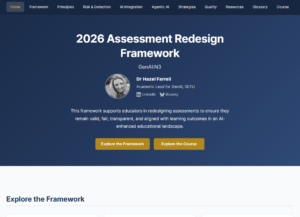
This OER presents an updated Assessment Redesign Framework for higher education in the age of GenAI. It supports educators and programme teams in designing valid, transparent, and scalable assessments, integrating AI literacy, process-focused approaches, and guidance on AI detection, large cohorts, and emerging agentic AI challenges.
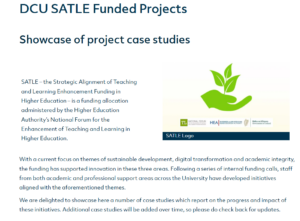
This resource showcases initiatives from both academic and professional support areas across DCU, which have been funded under SATLE – the Strategic Alignment of Teaching and Learning Enhancement Funding in Higher Education. Examples are provided under the themes of Education for Sustainable Development, Digital transformation & Academic Integrity
This Podcast Series has been developed by CPID Staff involved in teaching and engaging in educational research. It consists of podcasts with well-known educational academics and experts, exploring various educational concepts/topics taught on programmes offered by the CPID, and on SATLE funded educational research projects.
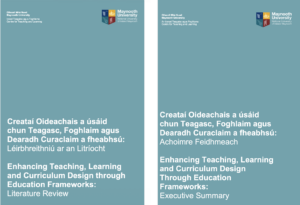
The resource comprises of a literature review and an executive summary, developed as part of the Maynooth University Leadership and EducAtion Framework (LEAF) initiative. It explores how education frameworks can enhance teaching, learning and curriculum design in higher education, supporting inclusive, sustainable and values-led academic practice.