DISE provides students with a curated library of video demonstrations, designed to empower them with the knowledge and skills needed to excel in science lab classes.
Benefit of this resource and how to make the best use of it
DISE provides students with access to a library of video demonstrations and resources that allow them to familiarize themselves with lab procedures and techniques before stepping into the physical lab. This pre-lab exposure reduces anxiety and builds confidence.
Watching video demonstrations allows students to become familiar with lab equipment, tools, and materials before entering the physical lab. This familiarity reduces the time required to get acclimated in the lab, allowing students to be more efficient during the actual experiment.
Students can progress through lab demonstrations at their own speed. Students can revisit specific topics or sections as many times as necessary to grasp the material fully, without the pressure of keeping up with a traditional lab pace
This work is licensed under a CC BY-NC-SA license, allowing sharing and adaptation for non-commercial use with proper attribution, provided derivative works use the same license.
?
This citation is automatically generated and may require adjustment. Always verify it against your style guide.
Finnegan, C. (12/02/2024). Dise: digital innovation in science education. National Resource Hub (Ireland). Retrieved from: https://hub.teachingandlearning.ie/resource/dise-digital-innovation-in-science-education/ License: Creative Commons Attribution-NonCommercial-ShareAlike (CC BY-NC-SA).
Adapting this resource? Share your version!
If you have modified or adopted this resource, share your version here. Tracking adaptations helps us measure impact and connects others with useful updates.
This is an interactive multimedia open educational resource (OER), created using H5P, on the topic of Open Education. It has been developed by the Department of Technology Enhanced Learning at Munster Technological University.
The purpose of which is to give an overview of OEPs, using interactive features of H5P
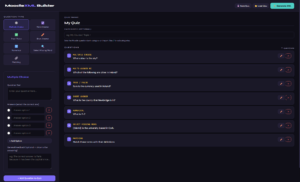
The purpose of this resource is to allow Moodle teachers to quickly create quizzes for Moodle. Users can quickly select between questions types through a single interface and export their questions as an XML file which can be imported into Moodle.
Conor Moynihan, Senior Engineer John Sisk & Sons. Structural Engineering @MTU Alumnus. In this video we meet Conor who graduated from MTU and is now a senior Engineer with Sisks in the UK.