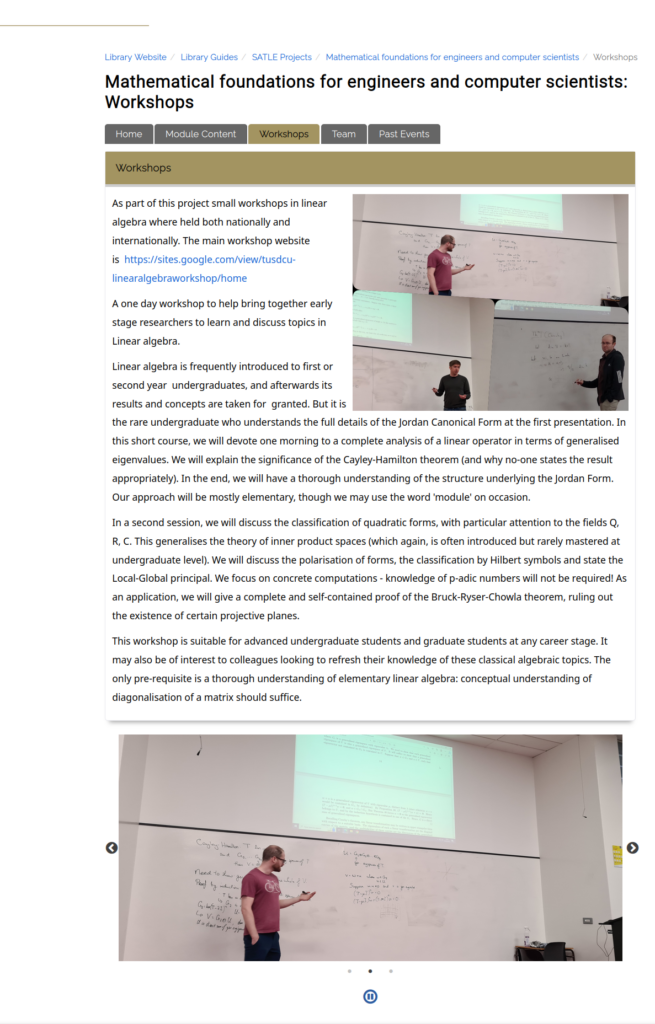
As part of this project small workshops in linear algebra where held both nationally and internationally. The main workshop website is https://sites.google.com/view/tusdcu-linearalgebraworkshop/home
A one day workshop to help bring together early stage researchers to learn and discuss topics in Linear algebra.
Benefit of this resource and how to make the best use of it
Linear algebra is frequently introduced to first or second year undergraduates, and afterwards its results and concepts are taken for granted. But it is the rare undergraduate who understands the full details of the Jordan Canonical Form at the first presentation. In this short course, we will devote one morning to a complete analysis of a linear operator in terms of generalised eigenvalues. We will explain the significance of the Cayley-Hamilton theorem (and why no-one states the result appropriately). In the end, we will have a thorough understanding of the structure underlying the Jordan Form. Our approach will be mostly elementary, though we may use the word ‘module’ on occasion.
This work is licensed under a CC BY-NC-SA license, allowing sharing and adaptation for non-commercial use with proper attribution, provided derivative works use the same license.
?
This citation is automatically generated and may require adjustment. Always verify it against your style guide.
Catháin, P. Ó., & Browne, P. (01/09/2025). Authentic stem education. National Resource Hub (Ireland). Retrieved from: https://hub.teachingandlearning.ie/resource/authentic-stem-education/ License: Creative Commons Attribution-NonCommercial-ShareAlike (CC BY-NC-SA).
Adapting this resource? Share your version!
If you have modified or adopted this resource, share your version here. Tracking adaptations helps us measure impact and connects others with useful updates.
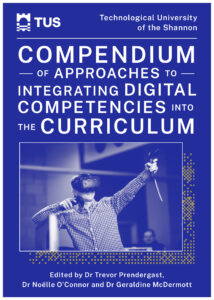
The Technological University of the Shannon (TUS) Compendium of Approaches to Integrating Digital Competencies into the Curriculum exemplifies the University’s commitment to embedding digital capability development across teaching, learning, and assessment.
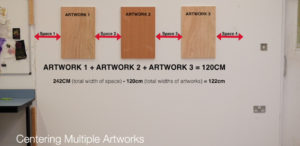
These video resources outline basic hanging and levelling methods used in the hanging and display of a variety of wall-based artworks, as well as demonstrating safe operation procedures for basic hand tools such as a drill, jigsaw, sander and nail gun.
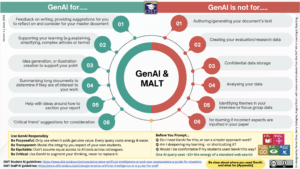
A 1-page guide, co-created by lecturers, tutors & students on DkIT's MA in Learning and Teaching, showing where GenAI can, and can't, support particular postgraduate research/skill development (*reflecting practice 2025-26). Includes student-informed prompts on responsible, sustainable use. An editable PowerPoint supports adaptation to own context.
Teaching and Assessment for Learning Checklists aimed at early career & seasoned lecturers. The checklists provide guidance & reliable curated resources for lecturers who want to deliver an engaging and positive learning experience for their students. They act as a guide to check existing approaches, and help analyse how improvements can be made.