CC BY-NC-SA

Sort by

Filter by

This lightning talk for NORFest 2025 introduces researchers to the benefits and impact of using OE Practices to disseminate and promote Open Research outputs. It introduces key concepts in open education, and provides practical tips on how to apply OE practices with a focus on reusability; licensing and copyright; and content co-creation.

These presentation slides, developed by Dr Amanda Platt and Colette Murphy (Ulster University) for the Advancing Quality and Leadership in Sustainable Higher Education workshop hosted by the Higher Education Authority (HEA), provide a detailed institutional case study of how Ulster University has systematically embedded Education for Sustainable Development (ESD) across all aspects of academic quality and curriculum design.

The slides outline Ulster’s six-year journey, highlighting strategic milestones including the development of the Integrated Curriculum Design Framework (ICDF), alignment with institutional strategies and sector frameworks such as QAA and Advance HE guidance, and successful accreditation under the SOS-UK Responsible Futures programme. They also illustrate how ESD principles have been built into programme approval, staff development, and quality enhancement processes—ensuring sustainability is embedded as a core academic value. The presentation provides an overview of Ulster’s commitment to collaboration, transparency, and evidence-based practice, offering valuable insights for institutions seeking to align ESD with academic standards, curriculum assurance, and sector quality codes.

These presentation slides, created and delivered by Dr Alex Ryan (Learning Energy) for the Advancing Quality and Leadership in Sustainable Higher Education workshop hosted by the Higher Education Authority (HEA), introduce the principles and practice of Anti-Greenwash Education within the context of Education for Sustainable Development (ESD).

The slides outline findings from the QAA-funded project Students Driving Curriculum Quality for Sustainability and provide a visual summary of how student-led approaches can strengthen transparency, quality, and credibility in sustainability education. They include key concepts, activity prompts, examples of course evaluation frameworks, and student feedback on applying ESD quality principles.

The workshop offered a structured overview of how institutions can embed authentic, evidence-based ESD across courses and policies, connecting workshop learning to wider sector priorities and the Government of Ireland’s ESD to 2030 Strategy.

In 2024/25 research was undertaken in higher education institutions in Ireland to explore commuter students’ experiences and to consider changes that would improve their experiences and outcomes. It addressed the questions: i. How does being a commuter student impact on student experiences and outcomes in higher education institutions in Ireland? ii. How can higher education institutions improve the experience and outcomes of commuter students? The study combined a semi-structured review and thematic analysis of the websites of the seven higher education institutions (HEIs) in Ireland, with two online ‘town hall focus groups’ (THFGs) involving 33 participants: six staff and 27 students, eight of whom were trained as facilitators and ‘jurors’ to reflect on the evidence heard. The THFGs addressed the key research questions, collecting individual responses via an online form; small groups discussed the topics and then a commuter student facilitator reported key points from their discussion into the main room. Commuter students generally found the experience of commuting to be quite negative, with few advantages. Furthermore, they felt their on-campus experience is not designed to facilitate their engagement. Students find that the organisation and delivery of the academic experience does not accommodate their needs, and they have few opportunities to engage with the wider student experience.

In Ireland around 40% of students remain in the family home – with their parents, partner or children – while participating in higher education (HE) and commute to their higher education institution (HEI). In 2024-25, the Technological Higher Education Association, now the Technological Universities Association (TUA) and the N-TUTORR Student Empowerment project leadership team, worked in partnership with Professor Liz Thomas, University of York. This resulted in an innovative project to explore commuter students’ experiences in Irish HEIs, and to consider changes that would improve the experience and outcomes for commuter students.

This Irish study builds on qualitative research undertaken in the UK (Thomas & Jones 2017). This found that commuter students are poorly defined, but self-identified commuters experienced commuting to be more tiring, stressful, and expensive than they imagined. They also reported lower engagement in some elements of the academic experience, and in the enhancement and social domains. Available secondary evidence finds that commuter student status is often correlated with not only poorer engagement but also lower outcomes, such as continuation, completion, attainment, and progression to graduate employment.

The study reported here addressed the following two questions:
i. How does being a commuter student impact on student experiences and outcomes in technological HEIs in Ireland
ii. How can technological HEIs improve the experience and outcomes of commuter students?

The study combined a semi-structured review and thematic analysis of the websites of the seven technological HEIs in Ireland, with two online ‘town hall focus groups’ (THFGs) involving 33 participants: six staff and 27 students, eight of whom were trained as facilitators and ‘jurors’ to reflect on the evidence heard. The THFGs addressed the key research questions, collecting individual responses via an online form; small groups discussed the topics and then a commuter student facilitator reported key points from their discussion into the main room. Ethical approval was secured from the University of York and participating HEIs.

This resource presents AVINA, an automated visual novel generator using large language models to transform multiple-choice questions into interactive learning narratives. Designed for educators and students, it supports gamified training in academic integrity and ethical decision-making through adaptive storytelling and experiential learning.

Blender is a free and open-source 3D creation suite that supports Windows, macOS, Linux, and other platforms. It is widely used for creating animated films, visual effects, 3D models for printing, motion graphics, video games, and virtual reality content. This guide acts as an introduction to becoming familiar with Blender.

In 2024/25 research was undertaken in higher education institutions in Ireland to explore commuter students’ experiences and to consider changes that would improve their experiences and outcomes. It addressed the questions: i. How does being a commuter student impact on student experiences and outcomes in higher education institutions in Ireland? ii. How can higher education institutions improve the experience and outcomes of commuter students? The study combined a semi-structured review and thematic analysis of the websites of the seven higher education institutions (HEIs) in Ireland, with two online ‘town hall focus groups’ (THFGs) involving 33 participants: six staff and 27 students, eight of whom were trained as facilitators and ‘jurors’ to reflect on the evidence heard. The THFGs addressed the key research questions, collecting individual responses via an online form; small groups discussed the topics and then a commuter student facilitator reported key points from their discussion into the main room.

In 2024/25 research was undertaken in higher education institutions in Ireland to explore commuter students’ experiences and to consider changes that would improve their experiences and outcomes. It addressed the questions: i. How does being a commuter student impact on student experiences and outcomes in higher education institutions in Ireland? ii. How can higher education institutions improve the experience and outcomes of commuter students? The study combined a semi-structured review and thematic analysis of the websites of the seven higher education institutions (HEIs) in Ireland, with two online ‘town hall focus groups’ (THFGs) involving 33 participants: six staff and 27 students, eight of whom were trained as facilitators and ‘jurors’ to reflect on the evidence heard. The THFGs addressed the key research questions, collecting individual responses via an online form; small groups discussed the topics and then a commuter student facilitator reported key points from their discussion into the main room. Commuter students generally found the experience of commuting to be quite negative, with few advantages. Furthermore, they felt their on-campus experience is not designed to facilitate their engagement. Students find that the organisation and delivery of the academic experience does not accommodate their needs, and they have few opportunities to engage with the wider student experience.

In 2024/25 research was undertaken in higher education institutions in Ireland to explore commuter students’ experiences and to consider changes that would improve their experiences and outcomes. It addressed the questions: i. How does being a commuter student impact on student experiences and outcomes in higher education institutions in Ireland? ii. How can higher education institutions improve the experience and outcomes of commuter students? The study combined a semi-structured review and thematic analysis of the websites of the seven higher education institutions (HEIs) in Ireland, with two online ‘town hall focus groups’ (THFGs) involving 33 participants: six staff and 27 students, eight of whom were trained as facilitators and ‘jurors’ to reflect on the evidence heard. The THFGs addressed the key research questions, collecting individual responses via an online form; small groups discussed the topics and then a commuter student facilitator reported key points from their discussion into the main room.

This paper describes the foundational principles and design details of the student-staff partnership initiative launched by the Co-creating Inclusive and Equitable Teaching & Learning project, led by Dr. Anna Santucci and situated within the Centre for the Integration of Research, Teaching and Learning (CIRTL) at University College Cork (UCC).

This 12 lesson open course provides an introduction to the AI Fluency Framework and the four competencies of Delegation, Description, Discernment, and Diligence. c. 70 mins videos plus ungraded exercises & projects and reference handouts. Co-developed by University College Cork, Ringling College and Anthropic with support by HEA.

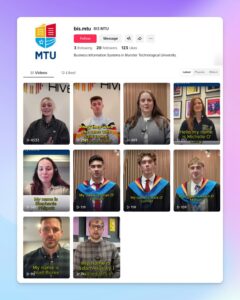
This playlist showcases real-world insights from BIS graduates, students, and employers, highlighting career paths, work placement experiences, and industry connections. Designed for prospective and current students, it offers an authentic look at how MTU’s BIS programme supports career development and professional growth.

It is with great pleasure that we present the proceedings from the
“Enhancing Academic Integrity: From Ideas to Action” conference, hosted
by CCT College Dublin on 3rd and 4th September 2024. This collection
represents the culmination of thoughtful discourse, innovative research, and
collaborative spirit that defined our gathering.

The VISIEN Framework Document is a strategic guide for integrating immersive technologies (AR, VR, MR, XR) into higher education. It offers practical guidance on curriculum integration, accessibility, collaboration, skill development, institutional readiness, and more to support transformative teaching, learning, and research.

This resource captures key insights from a full-day workshop held on 8 May 2025, hosted by the Higher Education Authority (HEA) and led by internationally recognised expert Dr Alison Cook-Sather. The event focused on the transformative potential of authentic student-staff partnerships as a strategic approach to advancing student engagement, success, and institutional effectiveness.

Attended by academic staff, institutional leaders, student success professionals, and sector partners from across Ireland, the workshop featured a combination of keynote presentations, lightning talks, and interactive sessions. Through real-world examples and hands-on activities, participants explored how to build meaningful, inclusive, and sustainable collaboration between students and staff.

For the full event schedule and a complete list of lightning talk contributors to this slide deck, visit the workshop schedule.

This document provides a summary of the book “MÉTODO DE LOS RELOJES. GRAMÁTICA DESCRIPTIVA DEL ESPAÑOL” authored by Manuel Perez Saiz, which serves as the foundation for the UCC Spanish grammar course.