Generative AI Guidance Microsite

[favorite_button]

Creator(s)

LEAD MIC

Organisation(s)

LEAD MIC

Discipline(s)

Teaching and Learning

Topic(s)

Digital Learning, Student Success

License

CC BY-NC-ND

Media Format

Website

Date Submitted

Submitted by

Export Resource Data

Description

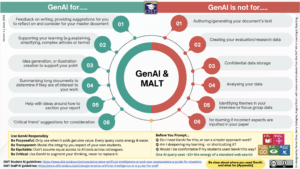
Generative AI Guidance Microsite provides resources and guidance to staff and students on the appropriate use of Generative AI in teaching and learning at MIC.

Benefit of this resource and how to make the best use of it

These guidelines cover a host of topics including:
Introduction to Generative Artificial Intelligence (GenAI)
Overview of the technologies’ possibilities and limitations
Outline of what acceptable use might look like for staff and students
Tips and guidance on how Generative AI can appropriately be incorporated in everyday use at MIC
Examples of Generative AI infringements
Considerations for grading in the context of GenAI
Glossary of key terms
These resources are intended to help staff and students navigate their use of Generative AI in a teaching and learning context

Creative Commons Attribution-NonCommercial-NoDerivatives (CC BY-NC-ND)

This work is licensed under a CC BY-NC-ND license, permitting redistribution for non-commercial use with proper attribution but prohibiting modifications.

https://creativecommons.org/licenses/by-nc-nd/4.0/
? This citation is automatically generated and may require adjustment. Always verify it against your style guide.
MIC, L. (16/09/2025). Generative ai guidance microsite. National Resource Hub (Ireland). Retrieved from: https://hub.teachingandlearning.ie/resource/generative-ai-guidance-microsite/ License: Creative Commons Attribution-NonCommercial-NoDerivatives (CC BY-NC-ND).

Adapting this resource? Share your version!

If you have modified or adopted this resource, share your version here. Tracking adaptations helps us measure impact and connects others with useful updates.

Related OER

This poster offers educators an overview of designing a syllabus on the Canvas learning management system that supports personalised learning pathways. It highlights (1) a gamified pedagogy grounded in gaming principles and (2) adaptive learning strategies using MasteryPaths.

This toolkit draws on our experiences facilitating a SATLE-funded community-engaged learning project that brought students of the School of Languages, Literatures, and Cultures (UCC) together with people in Cork seeking international protection for a series of three wellbeing and creativity workshops.

The HEA Education for Sustainable Development Spotlight Series 2025: Case Studies Compendium brings together 115 case studies from higher education institutions across Ireland. It showcases how universities and colleges are integrating sustainability and the UN Sustainable Development Goals into teaching, research, curriculum design, assessment practices and community engagement. It offers a comprehensive picture of national ESD activity and provides an accessible resource for educators and policymakers seeking examples of practice-based innovation.