Guidelines for the Governance of Digital Platforms

[favorite_button]

Creator(s) (alphabetical)

Organisation(s)

UNESCO

Discipline(s)

Topic(s)

Digital Learning

License

CC BY-SA

Media Format

PDF document

Date Submitted

Submitted by

Export Resource Data

Description

Safeguarding freedom of expression and access to information through a multistakeholder approach

Benefit of this resource and how to make the best use of it

The Guidelines outline a set of duties, responsibilities and roles for States, digital platforms, intergovernmental organizations, civil society, media, academia, the technical community and other stakeholders to enable the environment where freedom of expression and information are in the core of digital platforms governance processes.

Creative Commons Attribution-ShareAlike (CC BY-SA)

This work is licensed under a CC BY-SA license, allowing adaptation and sharing with proper attribution, provided derivative works use the same license.

https://creativecommons.org/licenses/by-sa/4.0/
? This citation is automatically generated and may require adjustment. Always verify it against your style guide.
UNESCO (2023). Guidelines for the governance of digital platforms. National Resource Hub (Ireland). Retrieved from: https://hub.teachingandlearning.ie/resource/guidelines-for-the-governance-of-digital-platforms/ License: Creative Commons Attribution-ShareAlike (CC BY-SA).

Adapting this resource? Share your version!

If you have modified or adopted this resource, share your version here. Tracking adaptations helps us measure impact and connects others with useful updates.

Related OER

This is an interactive multimedia open educational resource (OER), created using H5P, on the topic of Open Education. It has been developed by the Department of Technology Enhanced Learning at Munster Technological University.

The purpose of which is to give an overview of OEPs, using interactive features of H5P
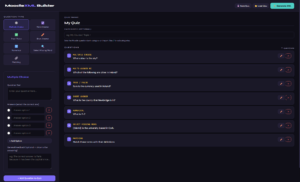
The purpose of this resource is to allow Moodle teachers to quickly create quizzes for Moodle. Users can quickly select between questions types through a single interface and export their questions as an XML file which can be imported into Moodle.

Moodle Quiz XML Builder

CC 0