This guide outlines some pedagogic considerations when designing take home offline exams or real-time online exams, both effectively ‘open book’ exams.
Benefit of this resource and how to make the best use of it
This resource supports educators who are considering the design and implementation of open-book exams. Approaches suitable to open-book exams are outlined, in addition to question formats that generally translate to this context. The OER also contains a concise guide around maximising academic integrity and deterring plagiarism / unauthorised collaboration. Finally, pedagogic considerations for open-books exams in the COVID-19 context at TCD are outlined. A helpful appendix is also linked in the resource, supporting the repurposing of face-to-face exam questions to open book exams.
Creative Commons Attribution (CC BY)
This work is licensed under a CC BY license, allowing sharing and adaptation with proper attribution.
?
This citation is automatically generated and may require adjustment. Always verify it against your style guide.
Centre for Academic Practice (CAPSL) at https://www.tcd.ie/CAPSL/, and Trinity College Dublin (2021). Designing open-book exams: guidance on the pedagogy. National Resource Hub (Ireland). Retrieved from: https://hub.teachingandlearning.ie/resource/designing-open-book-exams-guidance-on-the-pedagogy/ License: Creative Commons Attribution (CC BY).
Adapting this resource? Share your version!
If you have modified or adopted this resource, share your version here. Tracking adaptations helps us measure impact and connects others with useful updates.
The purpose of this resource is to allow Moodle teachers to quickly create quizzes for Moodle. Users can quickly select between questions types through a single interface and export their questions as an XML file which can be imported into Moodle.
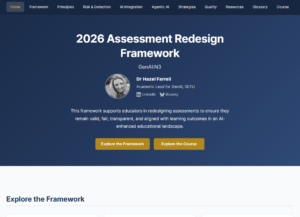
This OER presents an updated Assessment Redesign Framework for higher education in the age of GenAI. It supports educators and programme teams in designing valid, transparent, and scalable assessments, integrating AI literacy, process-focused approaches, and guidance on AI detection, large cohorts, and emerging agentic AI challenges.
This resource showcases initiatives from both academic and professional support areas across DCU, which have been funded under SATLE – the Strategic Alignment of Teaching and Learning Enhancement Funding in Higher Education. Examples are provided under the themes of Education for Sustainable Development, Digital transformation & Academic Integrity
This Podcast Series has been developed by CPID Staff involved in teaching and engaging in educational research. It consists of podcasts with well-known educational academics and experts, exploring various educational concepts/topics taught on programmes offered by the CPID, and on SATLE funded educational research projects.