Student Success

Sort by

Filter by

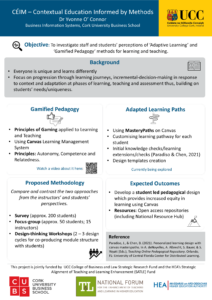
This poster offers educators an overview of designing a syllabus on the Canvas learning management system that supports personalised learning pathways. It highlights (1) a gamified pedagogy grounded in gaming principles and (2) adaptive learning strategies using MasteryPaths.

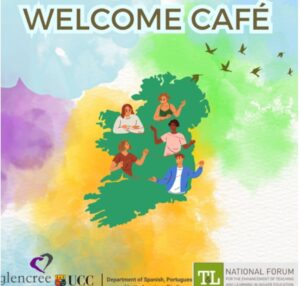
This toolkit draws on our experiences facilitating a SATLE-funded community-engaged learning project that brought students of the School of Languages, Literatures, and Cultures (UCC) together with people in Cork seeking international protection for a series of three wellbeing and creativity workshops.

The HEA Education for Sustainable Development Spotlight Series 2025: Case Studies Compendium brings together 115 case studies from higher education institutions across Ireland. It showcases how universities and colleges are integrating sustainability and the UN Sustainable Development Goals into teaching, research, curriculum design, assessment practices and community engagement. It offers a comprehensive picture of national ESD activity and provides an accessible resource for educators and policymakers seeking examples of practice-based innovation.

A collection of case studies of evidence-informed interventions implemented by higher education institutions in Ireland to support student retention and progression across the undergraduate lifecycle. These exemplars are presented here as a national evidence base of student progression initiatives.

In 2024/25 research was undertaken in higher education institutions in Ireland to explore commuter students’ experiences and to consider changes that would improve their experiences and outcomes. It addressed the questions: i. How does being a commuter student impact on student experiences and outcomes in higher education institutions in Ireland? ii. How can higher education institutions improve the experience and outcomes of commuter students? The study combined a semi-structured review and thematic analysis of the websites of the seven higher education institutions (HEIs) in Ireland, with two online ‘town hall focus groups’ (THFGs) involving 33 participants: six staff and 27 students, eight of whom were trained as facilitators and ‘jurors’ to reflect on the evidence heard. The THFGs addressed the key research questions, collecting individual responses via an online form; small groups discussed the topics and then a commuter student facilitator reported key points from their discussion into the main room. Commuter students generally found the experience of commuting to be quite negative, with few advantages. Furthermore, they felt their on-campus experience is not designed to facilitate their engagement. Students find that the organisation and delivery of the academic experience does not accommodate their needs, and they have few opportunities to engage with the wider student experience.

In Ireland around 40% of students remain in the family home – with their parents, partner or children – while participating in higher education (HE) and commute to their higher education institution (HEI). In 2024-25, the Technological Higher Education Association, now the Technological Universities Association (TUA) and the N-TUTORR Student Empowerment project leadership team, worked in partnership with Professor Liz Thomas, University of York. This resulted in an innovative project to explore commuter students’ experiences in Irish HEIs, and to consider changes that would improve the experience and outcomes for commuter students.

This Irish study builds on qualitative research undertaken in the UK (Thomas & Jones 2017). This found that commuter students are poorly defined, but self-identified commuters experienced commuting to be more tiring, stressful, and expensive than they imagined. They also reported lower engagement in some elements of the academic experience, and in the enhancement and social domains. Available secondary evidence finds that commuter student status is often correlated with not only poorer engagement but also lower outcomes, such as continuation, completion, attainment, and progression to graduate employment.

The study reported here addressed the following two questions:
i. How does being a commuter student impact on student experiences and outcomes in technological HEIs in Ireland
ii. How can technological HEIs improve the experience and outcomes of commuter students?

The study combined a semi-structured review and thematic analysis of the websites of the seven technological HEIs in Ireland, with two online ‘town hall focus groups’ (THFGs) involving 33 participants: six staff and 27 students, eight of whom were trained as facilitators and ‘jurors’ to reflect on the evidence heard. The THFGs addressed the key research questions, collecting individual responses via an online form; small groups discussed the topics and then a commuter student facilitator reported key points from their discussion into the main room. Ethical approval was secured from the University of York and participating HEIs.

In 2024/25 research was undertaken in higher education institutions in Ireland to explore commuter students’ experiences and to consider changes that would improve their experiences and outcomes. It addressed the questions: i. How does being a commuter student impact on student experiences and outcomes in higher education institutions in Ireland? ii. How can higher education institutions improve the experience and outcomes of commuter students? The study combined a semi-structured review and thematic analysis of the websites of the seven higher education institutions (HEIs) in Ireland, with two online ‘town hall focus groups’ (THFGs) involving 33 participants: six staff and 27 students, eight of whom were trained as facilitators and ‘jurors’ to reflect on the evidence heard. The THFGs addressed the key research questions, collecting individual responses via an online form; small groups discussed the topics and then a commuter student facilitator reported key points from their discussion into the main room.

In 2024/25 research was undertaken in higher education institutions in Ireland to explore commuter students’ experiences and to consider changes that would improve their experiences and outcomes. It addressed the questions: i. How does being a commuter student impact on student experiences and outcomes in higher education institutions in Ireland? ii. How can higher education institutions improve the experience and outcomes of commuter students? The study combined a semi-structured review and thematic analysis of the websites of the seven higher education institutions (HEIs) in Ireland, with two online ‘town hall focus groups’ (THFGs) involving 33 participants: six staff and 27 students, eight of whom were trained as facilitators and ‘jurors’ to reflect on the evidence heard. The THFGs addressed the key research questions, collecting individual responses via an online form; small groups discussed the topics and then a commuter student facilitator reported key points from their discussion into the main room. Commuter students generally found the experience of commuting to be quite negative, with few advantages. Furthermore, they felt their on-campus experience is not designed to facilitate their engagement. Students find that the organisation and delivery of the academic experience does not accommodate their needs, and they have few opportunities to engage with the wider student experience.

In 2024/25 research was undertaken in higher education institutions in Ireland to explore commuter students’ experiences and to consider changes that would improve their experiences and outcomes. It addressed the questions: i. How does being a commuter student impact on student experiences and outcomes in higher education institutions in Ireland? ii. How can higher education institutions improve the experience and outcomes of commuter students? The study combined a semi-structured review and thematic analysis of the websites of the seven higher education institutions (HEIs) in Ireland, with two online ‘town hall focus groups’ (THFGs) involving 33 participants: six staff and 27 students, eight of whom were trained as facilitators and ‘jurors’ to reflect on the evidence heard. The THFGs addressed the key research questions, collecting individual responses via an online form; small groups discussed the topics and then a commuter student facilitator reported key points from their discussion into the main room.

The resource is a template for surveying students about their timetabling experiences. The survey was deployed in MTU, but the template is free to be copied and adapted as needed.

The report – Generative AI in Higher Education Teaching and Learning: Sectoral Perspectives – was commissioned as part of the Higher Education Authority’s evidence-led approach to policy development.

The report captures the views of staff, students, and leaders across the Irish higher education system on the opportunities and challenges posed by artificial intelligence.

It brings together insights from ten thematic focus groups and a leadership summit, involving over 80 participants from across Ireland’s higher education institutions, alongside student representatives and sectoral stakeholders.

Generative AI Guidance Microsite provides resources and guidance to staff and students on the appropriate use of Generative AI in teaching and learning at MIC.

This report presents the findings and recommendations of the 2025 Expert Group review of the Irish National Framework for Student Success in Higher Education. Commissioned by the HEA, it explores how the framework and accompanying toolkit have been engaged with across the sector and outlines a renewed vision for student success that is inclusive, strategic, and evidence-informed.

This GenAI Learning Hub was developed with students, for students, to support the responsible and effective use of generative AI. Topics are divided across three main sections to aid understanding of GenAI before use, during use, and in relation to assessment. While aimed at students, this resource will be useful to anyone using GenAI.

GenAI Learning Hub

CC BY-NC

This paper describes the foundational principles and design details of the student-staff partnership initiative launched by the Co-creating Inclusive and Equitable Teaching & Learning project, led by Dr. Anna Santucci and situated within the Centre for the Integration of Research, Teaching and Learning (CIRTL) at University College Cork (UCC).

This e-book reports on a SATLE-funded project to explore the use of immersive technologies in Higher Education. It includes case studies, practical guidance and a brief review of the literature on immersive learning from the project team. It is intended for those considering using VR in their teaching, and for those who support learning.