CC BY-SA

Sort by

Filter by

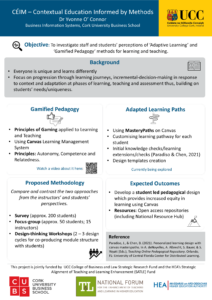
This poster offers educators an overview of designing a syllabus on the Canvas learning management system that supports personalised learning pathways. It highlights (1) a gamified pedagogy grounded in gaming principles and (2) adaptive learning strategies using MasteryPaths.

BSEditor is a multi-platform software tool designed to aid educators in the creation of computer-based quiz questions. It provides a powerful editor to easily control every detail of a question, from integration of files and images, to elaborate scoring approaches.

The Manifesto for Generative AI in Higher Education is a living resource for educators, students, and institutions. It invites reflection and dialogue across thirty statements exploring teaching, ethics, and imagination – helping higher education navigate AI with curiosity, integrity, and humanity.

This Toolkit was created by students at University College Dublin, for students, to break down sustainability in a way that’s simple and easy to understand. Climate change is something that affects all of us—no matter what you’re studying, where you’re from, or what you do. It’s here, and it’s impacting our world—but many of us aren’t sure what we can do about it.

The purpose of this toolkit is a starting point for what students need to learn about living more sustainably on and off campus. We hope it’ll inspire students to take small steps that make a big impact, and they can do it all at their own pace. You can access the Moodle page to view the Toolkit. There are also Zip files of the SCORM packages used to create the Toolkit (Part 1 and Part 2) that can be downloaded and imported into a Virtual Learning Environment.

• Part 1: Climate Change → Watch short Youtube videos followed by a little quiz to brush up on your sustainability knowledge.
• Part 2: What Can You Do? → Find tips and tricks to incorporate sustainability into your day-to-day life, this is a resource tool to help you get started!

We were both impressed and worried to witness the rapid escalation in the ability of tools like ChatGPT to conjure credible-seeming scholarly prose ex-nihilo. Rather than leaving the assessment strategy in MEEN3010 exposed to AI plagiarism, we decided to shift the focus towards a more authentic and interactive learning activity; a poster session.

Y. Mormul, J. Przybyszewski, A. Nakoud and P. Cuffe, “Reliance on Artificial Intelligence Tools May Displace Research Skills Acquisition Within Engineering Doctoral Programmes: Examples and Implications”, presented at IEEE International Conference on IT in Higher Education and Training, Paris, France, November 2024

The OER Recommendation aims to assist Member States to support the development and sharing of openly licensed learning and teaching materials, benefiting students, teachers, and researchers worldwide. It supports the creation, use and adaptation of inclusive and quality OER, and facilitates international cooperation in this field through five Action Areas, namely (i) building the capacity of stakeholders to create, access, re-use, adapt and redistribute OER; (ii) developing supportive policy; (iii) encouraging inclusive and equitable quality OER; (iv) nurturing the creation of sustainability models for OER, and (v) facilitating international cooperation.

The OER Recommendation aims to assist Member States to support the development and sharing of openly licensed learning and teaching materials, benefiting students, teachers, and researchers worldwide. It supports the creation, use and adaptation of inclusive and quality OER, and facilitates international cooperation in this field through five Action Areas, namely (i) building the capacity of stakeholders to create, access, re-use, adapt and redistribute OER; (ii) developing supportive policy; (iii) encouraging inclusive and equitable quality OER; (iv) nurturing the creation of sustainability models for OER, and (v) facilitating international cooperation.

The self-assessment guidelines contain policy-oriented questions with good practice examples from countries that have successfully implemented policies for FLPs in their higher education systems. These examples are drawn from the national case studies implemented under the IIEP research, as well as from a broader review of the literature. The guidelines also include key bibliographical references for further reading related to these policy questions.

These guides have been prepared by UNESCO, as part of its programme of the support to governments and educational institutions in the implementation of the UNESCO OER Recommendation. They draw heavily on the in-depth background papers prepared by OER experts from around the world in each of the five Action Areas: Prof. Melinda dP. Bandalaria (building the capacity of stakeholders to create, access, re-use, adapt and redistribute OER); Dr Javiera Atenas (developing supportive policy); Dr Ahmed Tlili (encouraging inclusive and equitable quality OER); Dr Tel Amiel (nurturing the creation of sustainability models for OER), and Ms Lisbeth Levey (facilitating international cooperation). We are deeply grateful for their assistance and expert knowledge. Preparation of the text of the final guides was done with support from Neil Butcher and Alison Zimmermann of OER Africa.

The “Recycling Art” project engages children in transforming waste into creative toys, fostering sustainable living habits and environmental consciousness in line with SDG 13, through imaginative and fun activities.

Recycling art

CC BY-SA

AI is expected to bring about profound changes for the higher education sector, presenting numerous opportunities as well as serious and urgent challenges that must be addressed in the transition towards AI-driven systems. This chapter provides a Practical Guide targeted at higher education leaders, setting out actionable recommendations and steps that can be taken at an institutional level to adapt to AI in a responsible and ethical manner. The Practical Guide has been designed with HEIs in resource-constrained contexts in mind, but it is also intended to be flexible and responsive to a range of local/ global institutional and regulatory situations. It signals actions that affect internal capacity building, institutional governance, teaching, research, and community engagement. These actions also include specific recommendations on gender equality that can lead to transformation by addressing the root causes of gender inequalities.

UNESCO’s first global guidance on GenAI in education aims to support countries to implement immediate actions, plan long-term policies and develop human capacity to ensure a human-centred vision of these new technologies. The Guidance presents an assessment of potential risks GenAI could pose to core humanistic values that promote human agency, inclusion, equity, gender equality, and linguistic and cultural diversities, as well as plural opinions and expressions. It proposes key steps for governmental agencies to regulate the use of GenAI tools including mandating the protection of data privacy and considering an age limit for their use. It outlines requirements for GenAI providers to enable their ethical and effective use in education.