

An IADT project applying Plain English and user testing to password change instructions, reset guides and FAQs, improving independent task completion and reducing requests for helpdesk support.
Initiative
ChemE: An Inter-Institutional Initiative for Chemical Engineering Education in Ireland
About this initiative
Irish Engineering Graduates Advancing Global Manufacturing Competitiveness: Design Simulation for the Process Industries
Overview of the project
Irish Chemical Engineering graduates have played a pivotal role in the development of the economically crucial pharma/biopharma sector in Ireland. This project harnesses all stakeholders, in the Irish Chemical/Process/Bioprocess Engineering education space, working together to ensure that teaching within the discipline is aligned with best pedagogical and professional practices, specifically with regard to design and simulation practices of relevance to the pharma/biopharma sector.
The academic participants (UCD, CIT, DCU, DIT, UCC, UL) are supported by external (non-funded) partners: practicing engineers and graduate employers from the process and consultancy sectors; simulation software developers/providers; IChemE, the international accreditation body for the Chemical Engineering profession.
This project yields suites of novel, shared, vertically-structured e-learning resources – to support students in integrating theory, experiment and simulation (using industry-standard simulation tools), across the different core modules of undergraduate Chemical Engineering curricula.
There are 4 main subject areas: Fermentation, Chromatography, Distillation and Process Control. Each subject area is addressed both experimentally and via simulation to reinforce the underpinning theory and to allow students to explore core concepts beyond the limitations of a single laboratory experiment.
The project also yields a strategy sustainably embedding the effective use of these tools within Chemical Engineering degree programmes (and cognate Sciences), for the achievement of professionally-relevant graduate skills.
The project commenced on March 1 2016. Lead partners met formally in early March. A whole-team Inception Workshop was hosted by NIBRT on March 22 2016. The second whole-team Workshop took place in UCC, on June 21 2016.
Key outcomes of the project
– A suite of reusable, shared, pedagogically-appropriate resources (including screencasts, video, animations, simulations, interactive environments and assessment activities), in key Chemical/Process Engineering subject areas, of direct relevance to pharma/biopharma applications, culminating in development of user proficiency in the intelligent deployment of sophisticated process simulation tools and techniques.
– Development of an open, online platform, to house project learning suites, ensuring that the developed resources remain available (for use, modification and supplementation) post-project.
Outline how the project benefits the higher education sector nationally
– An exemplar project for similar initiatives within allied academic programmes, nationally and internationally, thereby raising the profile of Irish Chemical/Process Engineering education and practice and supporting the development and achievement of professional accreditation standards.
– Development of a cross-disciplinary community of engineering education practice, directly aligned to the needs of the pharma/biopharma sector, supporting enhanced and extended strategic partnerships between all relevant stakeholders, with a specific focus on student learning and development of core competencies.
– A coherently articulated, ‘spiral learning’ structured, theory-experiment-simulation approach, within Chemical/Process Engineering and cognate curricula in Ireland, specifically in the context of pharma/biopharma applications.
– Professional development for staff (academic, technical and support) on best practice in curriculum design and delivery of theory-experiment-simulation learning frameworks within undergraduate Chemical/Process Engineering.
– A platform, developed for full-time academic programmes but which provides a framework than can be adapted to address specific needs of the pharma/biopharma sector in terms of training and upskilling.
Outline how the project benefits students
– The project itself is characterized by – and depends entirely upon – direct engagement of and with students, in developing the relevant experimental systems and associated simulations/exercises; in the iterative evaluation of resources, both through focus groups and in module-based pilot studies; in the use of the resources.
– Ultimately, the provision of authentic, incremental learning and assessment experiences for students, yielding enhanced graduate awareness and preparedness (particularly with regard to digital literacy) to enter and play higher-value professional roles in the pharma/biopharma sector.
Other national/international development work that complements this project
– The project team worked with the IChemE EdSIG, towards a Chemical/Process Engineering T&L Community of Engagement to champion and further the implementation and evaluation of the project during post-project roll-out, beyond the Irish Higher Education sector.
– The project builds directly from examples of relevant, high-quality multi-media pedagogical resources as developed, applied and evaluated within the Chemical Engineering education community in the US.
Who to contact for more information
Dr. Patricia Kieran
Project Coordinator
UCD School of Chemical & Bioprocess Engineering
UCD, Belfield, Dublin 4.
Academic Partners
UCD – School of Chemical & Bioprocess Engineering
Dr. Patricia Kieran, Project Coordinator; Dr. Damian Mooney, Lead, Distillation.
Institutional Participants: Prof. Eoin Casey; Prof. Brian Glennon; Prof. Don MacElroy; Dr. Philip Donnellan; Dr. Niall English; Dr. Dermot Malone; Dr. David O’Connell.
UCD – School of Biomolecular & Biomedical Science
Dr. Carmel Hensey. Lead, Chromatography
UCD Teaching & Learning
Dr. Aine Galvin, Director, UCD T&L;
CIT – Department of Process, Transport & Energy Engineering
Dr. Michael J. O’Mahony, Head of Dept
Institutional Participants: Noel Duffy; Dr. Roisín Foley; Dr. Sandra Lenihan; Dr. Michael D. Murphy; Darragh Coakley.
CIT – Department of Technology Enhanced Learning
Dr. Gearóid Ó Súilleabháin, Lead, Multi-media Resource Development
DCU – School of Biotechnology
Dr. Brian Freeland, Lead, Fermentation
Institutional Participants: Dr. Greg Foley; Dr. Jenny Lawler
DIT – School of Electrical Engineering Systems
Dr. David Dorran, Lead, Process Control
Institutional Participant: Gavin Duffy
UCC – School of Engineering (Process & Chemical)
Dr. Jorge Oliveira, Programme Director
Institutional Participants: Dr. Maria Gallagher; Dr. Denis Ring.
UL – Chemical and Environmental Sciences Department
Dr. Witold Kwapinski, Programme Director
Institutional Participant: Dr. Denise Croker
External (non-funded) Partners
The project team gratefully acknowledges the generous support and active involvement of the following external partners: APC – www.approcess.com; IChemE Education Special Interest Group (EdSIG) – www.icheme.org; Jacobs Engineering – www.jacobs.com; National Institute for Bioprocessing Research & Training (NIBRT) – www.nibrt.ie; Scale-Up Systems (DynoChem) – www.scale-up.com.
Project Update (November 2015)
Project Update (June 2016)
Project Update (February 2017)
Project Update (November 2017)
Lead organisations
Affiliated organisations
Linked open educational resources
Initiative details
Funding programmes Teaching and Learning Enhancement Fund 2014-18
Status
CompletedAward year
2015End year
2017Contributors
Related initiatives

A Concrete Approach to Learning Algebraic Coding Theory Using a Computer Algebra System
Coding theory is a major component of Applied Algebra. It has many applications in the mathematics of communications and has many links with other scientific disciplines, such as electrical engineering and computer science. Coding theory arises in almost every imaginable digital communications and storage system. In UCD, it is taught at the undergraduate level in the module MATH30180 An Introduction to Coding Theory.
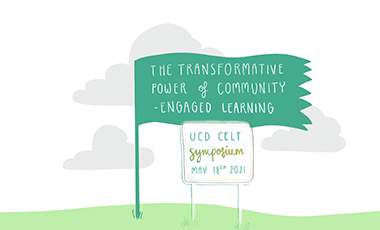
UCD Community Engaged Learning and Teaching (CELT) Community of Practice
Community Engaged Learning and Teaching is considered to be transformative for students and practitioners, underpinned by civic participation in community and society. One of the strategic themes of the UCD Rising to the Future Strategy is “Building a Healthy World” a core objective of which is to “continue to build our engagement locally, nationally and internationally”. Community Engaged Learning (CEL) and Teaching affords the University an opportunity to build and strengthen strong partnerships with social and community organisations in a meaningful and transformative way. It provides faculty, students and community organisations opportunities to engage in a symbiotic manner, learning from each other whilst bridging the gap between academic learning and the lived reality(ies) of society.