A webinar which addresses the following questions: During the session, we will also discuss the questions: What is learning design in 2021 and post-pandemic? How does learning design differ from instructional design? What is next for the learning designer? What is the future of the learning designer’s role? Where does the learner designer fit in the new digital learning ecology? What barriers do learning designers face? How can reflective learning design improve student experience?
Benefit of this resource and how to make the best use of it
Indeed, today most teachers and educators work in an online learning environment, yet for many of them their immersion in online teaching was a necessary response to the global pandemic. Overnight we changed physical, traditional, learning environment to an online environment. This brought many challenges for teachers. A high number of them needed different and new skills and experiences in teaching as well as the support and collaboration with people of different backgrounds and expertise. Support units, learning technologists and instructional and learners designers now become more than ever in focus by extensively helping teachers to navigate this new environment and select appropriate tools for planned activities, to implement new pedagogies, and to design efficient, effective and enjoyable learning experience for their students. Learning designers across the globe led teachers out of the storm. The pandemic forced steps forward and an online pivot that were planned and foreseen for many years and prompted teachers everywhere into action by opening new opportunities for teaching and learning and highlighting the critical importance of learning design. In addition, it has moved the focus from content creation to the users learning experience supported by appropriate learning environments. How teachers navigated these pedagogical changes, what kind of challenges they experienced and what kind of support they required with designing their courses is the topic of this session.
During the session, we will also discuss the questions:
What is learning design in 2021 and post-pandemic?
How does learning design differ from instructional design?
What is next for the learning designer?
What is the future of the learning designer’s role?
Where does the learner designer fit in the new digital learning ecology?
What barriers do learning designers face?
How can reflective learning design improve student experience?
?
This citation is automatically generated and may require adjustment. Always verify it against your style guide.
Mihai, A., Súilleabháin, G. Ó., Barratt, N., & Softić, S. K. (2021). Learning design in the eye of the storm. National Resource Hub (Ireland). Retrieved from: https://hub.teachingandlearning.ie/resource/learning-design-in-the-eye-of-the-storm/ License: Creative Commons Attribution (CC BY).
Adapting this resource? Share your version!
If you have modified or adopted this resource, share your version here. Tracking adaptations helps us measure impact and connects others with useful updates.
Teaching and Assessment for Learning Checklists aimed at early career & seasoned lecturers. The checklists provide guidance & reliable curated resources for lecturers who want to deliver an engaging and positive learning experience for their students. They act as a guide to check existing approaches, and help analyse how improvements can be made.
Team Tool is an open educational resource (OER) designed to support equitable,
e ective teamwork in higher education. It was developed in response to persistent
challenges in collaborative work, including uneven contribution, lack of
accountability and student dislike and anxiety around group projects.
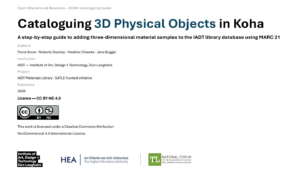
This open educational resource provides a step-by-step guide to cataloguing three-dimensional physical objects — primarily material samples — in Koha, the open-source Library Management System.