These guides have been prepared by UNESCO, as part of its programme of support to governments and educational institutions in implementation of the UNESCO OER Recommendation.
Benefit of this resource and how to make the best use of it
The OER Recommendation aims to assist Member States at the national level by supporting the development and sharing of openly licensed learning and teaching materials, benefiting students, teachers and researchers worldwide. It supports the creation, use and adaptation of inclusive and quality OER, and facilitates international cooperation in this field through five Action Areas, namely: (i) building the capacity of stakeholders to create, access, re-use, adapt and redistribute OER; (ii) developing supportive policy; (iii) encouraging inclusive and equitable quality OER; (iv) nurturing the creation of sustainability models for OER, and (v) facilitating international cooperation. In addition, it contributes to the building of open and inclusive knowledge societies, and to the achievement of the 2030 Agenda for Sustainable Development, namely SDG 4 (Quality education), SDG S (Gender equality), SDG 9 (Industry, innovation and infrastructure), SDG 10 (Reduced inequalities within and among countries), SDG 16 (Peace, justice and strong institutions) and SDG 17 (Partnerships for the goals). Operationalizing the Recommendation remains a challenge for governments and institutions, as it requires a range of policies, capacity-building and strategies to fully realize its potential in facilitating the achievement of these SDGs.
This work is licensed under a CC BY-SA license, allowing adaptation and sharing with proper attribution, provided derivative works use the same license.
?
This citation is automatically generated and may require adjustment. Always verify it against your style guide.
UNESCO (2024). Guidelines on the implementation of the oer recommendation action area 5: promoting and reinforcing international cooperation. National Resource Hub (Ireland). Retrieved from: https://hub.teachingandlearning.ie/resource/guidelines-on-the-implementation-of-the-oer-recommendation-action-area-5-promoting-and-reinforcing-international-cooperation/ License: Creative Commons Attribution-ShareAlike (CC BY-SA).
Adapting this resource? Share your version!
If you have modified or adopted this resource, share your version here. Tracking adaptations helps us measure impact and connects others with useful updates.
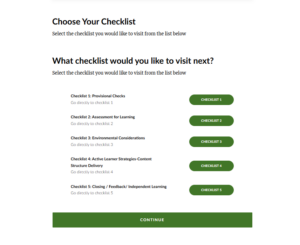
Teaching and Assessment for Learning Checklists aimed at early career & seasoned lecturers. The checklists provide guidance & reliable curated resources for lecturers who want to deliver an engaging and positive learning experience for their students. They act as a guide to check existing approaches, and help analyse how improvements can be made.
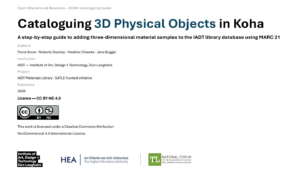
This open educational resource provides a step-by-step guide to cataloguing three-dimensional physical objects — primarily material samples — in Koha, the open-source Library Management System.
Title: Gasta Talks – Open Education in Practice
Chaired by: Dr Tom Farrelly (MTU)
Short, high-energy 5-minute lightning talks designed to encourage broad participation and rapid sharing of ideas and experiences.
– Ken McCarthy (SETU)* – Open by Design: A Manifesto for Generative AI in Higher Education
– Angélica Rísquez (UL)* – Why Open Still Matters (Just Differently)
– Susan Horgan (MTU)* – Digital Inclusion in Online Learning
– Carina Ginty (ATU)* – Unlock Your Digital & Green Superpowers: Explore the AREA Discovery Tool
– Michael Costello (MTU)* – Partnership to Practice: Developing OER at MTU
Keynote Title: Opening the Future: Equity, Sustainability, and Promise in Higher Education
Speaker: Dr Robin DeRosa
Dr Robin DeRosa is the Executive Director of the Open Education Network , a global organization based out of the University of Minnesota that facilitates community care and collective action in open education to empower faculty, remove barriers to learning and knowledge-sharing, and enhance student success.