Throughout this workbook students are asked to engage with the PCs Graduate Attribute & Mindsets Framework via a suite of activities or exercises. This engagement will provide students with the language of skills and attributes best suited to job application and success.
Benefit of this resource and how to make the best use of it
At DkIT our careers research has shown that employability and graduate attributes go hand-in-hand together. Your graduate attributes are the core abilities and values your higher education institute community, including students and graduates, agrees all graduates should develop. They are also the abilities employers deem necessary for today’s knowledge workers and graduate success.
At DkIT our graduate attribute framework emphasises practical, collaboration, communication, and confidence skills as well as positive, adaptive and resilient mindsets. We advocate ‘ Graduates Bringing Practical Solutions to a Complex World ’ as ‘Communicators, Collaborators and Confident Changemakers ’.
Throughout this workbook you will be asked to engage with the PCs Graduate Attribute & Mindsets Framework via a suite of activities and exercises. Your engagement will provide you with the language of skills and attributes best suited to job application and success. We have consulted a wide range of stakeholders who agree that when twinned with innovative pedagogy, this graduate-attribute framework and workings will produce outstanding graduate job applicants and employees.
?
This citation is automatically generated and may require adjustment. Always verify it against your style guide.
Staunton, C. (2022). Graduate attributes workbook. National Resource Hub (Ireland). Retrieved from: https://hub.teachingandlearning.ie/resource/graduate-attributes-workbook/ License: Creative Commons Attribution-NonCommercial (CC BY-NC).
Adapting this resource? Share your version!
If you have modified or adopted this resource, share your version here. Tracking adaptations helps us measure impact and connects others with useful updates.
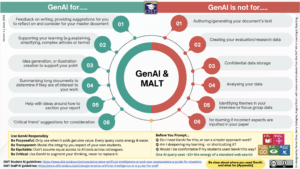
A 1-page guide, co-created by lecturers, tutors & students on DkIT's MA in Learning and Teaching, showing where GenAI can, and can't, support particular postgraduate research/skill development (*reflecting practice 2025-26). Includes student-informed prompts on responsible, sustainable use. An editable PowerPoint supports adaptation to own context.
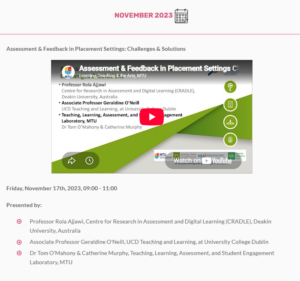
MTU researchers, together with national and international researchers, presented local, national, and global insights into the challenges and opportunities of assessment and feedback in work placement settings.
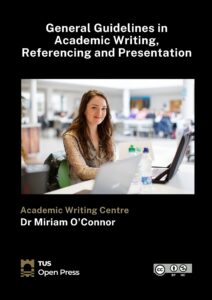
This book is designed specifically for students studying at the Technological University of the Shannon – Midlands Midwest, Ireland. It presents a step-by-step practical guide to academic writing, referencing and presentation, with clear explanations and structured approaches with examples that support the development of clear and concise writing.
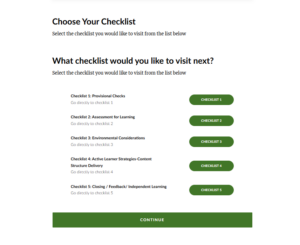
Teaching and Assessment for Learning Checklists aimed at early career & seasoned lecturers. The checklists provide guidance & reliable curated resources for lecturers who want to deliver an engaging and positive learning experience for their students. They act as a guide to check existing approaches, and help analyse how improvements can be made.