This resource was created from the SATLE 2018 initiative: Higher Education Language Educators’ Competences (HELECs ).
Benefit of this resource and how to make the best use of it
The HELECs framework of competences comprises seven domains, reflecting the multidimensionality of the language educator in higher education. The circular theme chosen for the visualisation of this framework emphasises the absence of a hierarchy between the domains. In other words, educators may identify with or choose any domain relevant to their needs, at any point time. Simply click on the name of the domain to access the corresponding competences.
Each domain is scaffolded by three competence identifiers, labelled Practitioner, Expert and Leader. The identifiers provide structure and support a transformative experience for language educators’ professional development in higher education.
?
This citation is automatically generated and may require adjustment. Always verify it against your style guide.
University College Cork (2021). The helecs framework of competences (interactive version). National Resource Hub (Ireland). Retrieved from: https://hub.teachingandlearning.ie/resource/the%e2%80%afhelecs%e2%80%afframework-of-competences-interactive-version/ License: Creative Commons Attribution-NonCommercial (CC BY-NC).
Adapting this resource? Share your version!
If you have modified or adopted this resource, share your version here. Tracking adaptations helps us measure impact and connects others with useful updates.
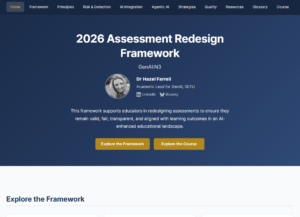
This OER presents an updated Assessment Redesign Framework for higher education in the age of GenAI. It supports educators and programme teams in designing valid, transparent, and scalable assessments, integrating AI literacy, process-focused approaches, and guidance on AI detection, large cohorts, and emerging agentic AI challenges.
The resource comprises of a literature review and an executive summary, developed as part of the Maynooth University Leadership and EducAtion Framework (LEAF) initiative. It explores how education frameworks can enhance teaching, learning and curriculum design in higher education, supporting inclusive, sustainable and values-led academic practice.
This resource describes the rational for, design of and implementation details associated with an initiative designed to support early career academic staff adopt evidence-based, active and inclusive learning strategies to enhance learning for ALL students.
Reimagining Assessment & Feedback Together (RAFT) is MTU initiative developed to transforming assessment practices. This volume documents twenty-four situated, discipline-specific attempts to rethink assessment and feedback through student partnership and action research.