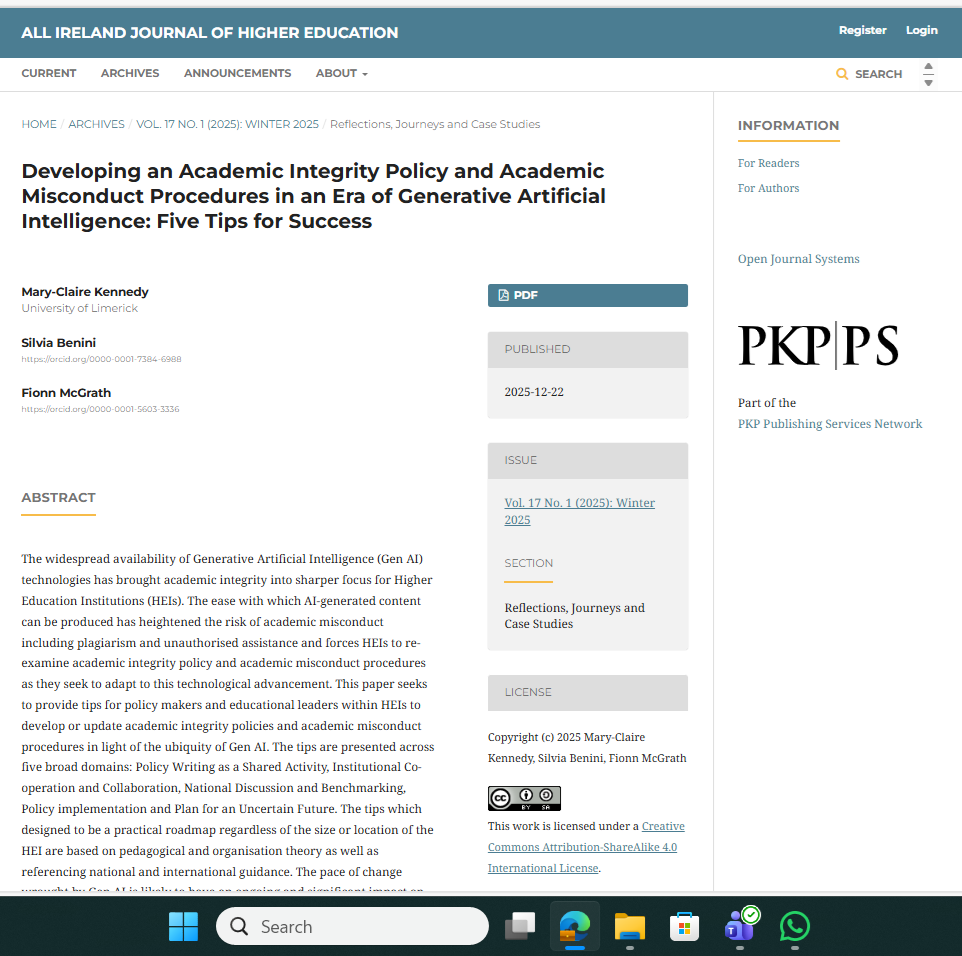
Academic Paper: Developing an Academic Integrity Policy and Academic Misconduct Procedures in an Era of Generative Artificial Intelligence: Five Tips for Success

[favorite_button]

Creator(s)

Fionn McGrath, Mary-Claire Kennnedy, Silvia Benini

Organisation(s)

University of Limerick

Discipline(s)

Teaching & Learning

Topic(s)

Other

License

CC BY-SA

Media Format

E-Book / Digital Publication

Date Submitted

Submitted by

Export Resource Data

Description

This paper entitled 'Developing an Academic Integrity Policy and Academic Misconduct Procedures in an Era of Generative Artificial Intelligence: Five Tips for Success' may be of interest to policy developers and educators in further and higher education and training organisations as they adapt to challenge of AI.
Benefit of this resource and how to make the best use of it

Creative Commons Attribution-ShareAlike (CC BY-SA)

This work is licensed under a CC BY-SA license, allowing adaptation and sharing with proper attribution, provided derivative works use the same license.

https://creativecommons.org/licenses/by-sa/4.0/
? This citation is automatically generated and may require adjustment. Always verify it against your style guide.
McGrath, F., Kennnedy, M., & Benini, S. (22/12/2025). Academic paper: developing an academic integrity policy and academic misconduct procedures in an era of generative artificial intelligence: five tips for success. National Resource Hub (Ireland). Retrieved from: https://hub.teachingandlearning.ie/resource/academic-paper-developing-an-academic-integrity-policy-and-academic-misconduct-procedures-in-an-era-of-generative-artificial-intelligence-five-tips-for-success/ License: Creative Commons Attribution-ShareAlike (CC BY-SA).

Adapting this resource? Share your version!

If you have modified or adopted this resource, share your version here. Tracking adaptations helps us measure impact and connects others with useful updates.

Related OER

Blender is a free and open-source 3D creation suite that supports Windows, macOS, Linux, and other platforms. It is widely used for creating animated films, visual effects, 3D models for printing, motion graphics, video games, and virtual reality content. This guide acts as an introduction to becoming familiar with Blender.

The Data Loom: Crafting Stories with Code, Yarn and Print is an open educational resource that reimagines data visualisation through tangible, artistic, and embodied practices. Instead of visualising numbers on screens, this project guides learners to materialise datasets using yarn, a miniature 3D-printed loom, and the art of weaving.