
Spotlight Series
ESD Case Study Collection
Examples of Education for Sustainable Development initiatives from across higher education in Ireland.
(Deadline: 17 October 2025)
| Initiative Details | |||||||||||||||||||||
|---|---|---|---|---|---|---|---|---|---|---|---|---|---|---|---|---|---|---|---|---|---|
| Title | Sustainable–Food/Sector–Curriculum Co-Create: Co-Designing OERs for Embedding Sustainability | ||||||||||||||||||||
| Contributor(s) |
| ||||||||||||||||||||
| Institution(s) and Partner Organisations |
| ||||||||||||||||||||
| Discipline(s) |
| ||||||||||||||||||||
| Programme(s) |
| ||||||||||||||||||||
| Student Engagement | Over 100 students participated in the pilot modules, while more than 500 students have since engaged with sustainability-embedded programmes. Students were active co-creators in the design, evaluation, and review of curricula, directly shaping sustainability learning outcomes and assessment approaches. | ||||||||||||||||||||
| Keywords | Sustainability Literacy, Co-creation, OER, Design Thinking, Curriculum Innovation | ||||||||||||||||||||
| Initiative Description | |||||||||||||||||||||
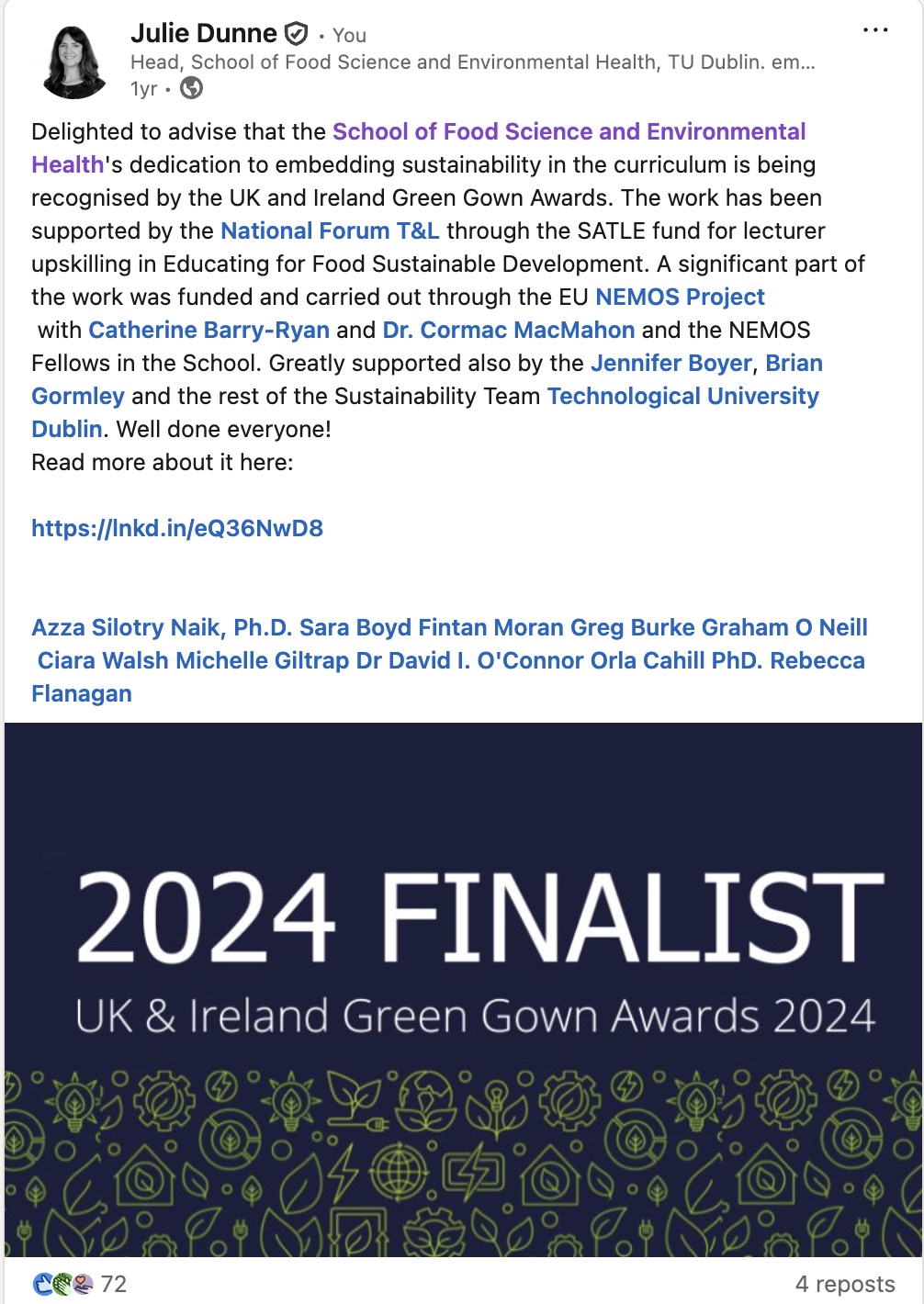
| Outline or Description | The Sustainable–Food/Sector–Curriculum Co-Create (SFCC/SSCC) initiative, funded through TU Dublin’s SATLE Impact “Synergies” and “Accelerate” schemes, was established to embed Education for Sustainable Development (ESD) across disciplinary programmes through co-creation with students, enterprise partners, and academic staff. It began within the School of Food Science and Environmental Health as a pilot to address TU Dublin’s Strategic Intent 2030 goal of integrating sustainability learning outcomes across all programmes. This led to the design of two pilot modules, validated and shared as open educational resources (OERs): Level 9 CPD Module: Educating for Food Sector Sustainability (2021) Level 8 Module: Food Sector Sustainability (2021) These were the first ESD modules validated in TU Dublin and served as demonstration exemplars for how to build capacity to allow existing modules to be reviewed and redesigned to embed disciplinary sustainability learning outcomes and assessments. The modules were used as practical guides within the SFCC pilot to support academic staff in a co-creation process with students and stakeholders to systematically align learning outcomes and assessment with the UN Sustainable Development Goals (SDGs). Each module included participatory workshops involving staff, students, and enterprise representatives (e.g., Bord Bia, Teagasc, Food Safety Authority of Ireland). The pedagogical model integrated design thinking, reflective learning, and SDG mapping to foster systems thinking and transformative learning. Building on their success, similar sector-focused ESD modules were co-created for Tourism and Hospitality, Business and Finance, and Biopharmaceuticals & Life Sciences, ensuring contextual relevance across TU Dublin’s disciplinary landscape. Following the pilots, the insights and evaluation data informed the creation of a general ESD CPD module for academic staff, now embedded within TU Dublin’s Postgraduate Diploma in University Teaching and Learning and the MA in Higher Education Practice. This module retains a discipline-specific sustainability learning outcome and assessment, requiring each participating lecturer to investigate sustainability within their own disciplinary context and design aligned learning and assessment strategies. The initiative has led to tangible institutional transformation: Capacity building among 35 lecturers across four sectors; Embedding of sustainability outcomes in 11 of 13 Food Science programmes; Establishment of a cross-campus Leading Sustainability Network; Publication and global reuse of OERs (500+ downloads). This project demonstrates how open educational practice can serve as both a pedagogical tool and a strategic lever for curriculum reform and institutional capacity-building in ESD. | ||||||||||||||||||||
| Collaboration, Partnerships & Student Participation | Students were central collaborators in curriculum co-design, contributing ideas for content, assessment, and module evaluation. Enterprise partners such as Bord Bia, Burren Ecotourism Network, Teagasc, Alexion, and the Food Safety Authority of Ireland co-shaped authentic sustainability challenges, ensuring sectoral relevance. Collaboration through the Convene Enterprise Academy linked enterprise and academia, while the LTTC supported pedagogical innovation. This cross-sectoral and multi-campus collaboration, spanning Food, Business, Tourism, and Biopharma, embodied the principle of knowledge co-production, empowering students, educators, and industry partners to co-create sustainability learning outcomes and disciplinary ESD frameworks. Further information: Dunne, J., et al (2021). ‘Sustainable–[sector]-curriculum co-create' Case study #45 in ‘Better together: knowledge co-production for a sustainable society’ Bolger, P., Brereton, P., Grant, O., Torney, D. and Gallagher, T., Royal Irish Academy Dunne, Julie L.; Barry-Ryan, Catherine; and MacMahon, Cormac H. (2024) "Embedding sustainability in food degrees: A Case-study of service-learning as a signature pedagogy for developing food sustainability competencies," Irish Journal of Academic Practice: Vol. 11: Iss. 2, Article 8. doi:https://doi.org/10.21427/vj65-ad03 Available at: https://arrow.tudublin.ie/ijap/vol11/iss2/8 | ||||||||||||||||||||
| Intended Learning Outcomes | An abbreviated summary of the LOs Level 9 (CPD – Educating for Food Sector Sustainability - full LOs available in the OER resource linked below): Critically evaluate frameworks and policies underpinning ESD. Design sustainability-focused learning outcomes and assessments for disciplinary contexts. Apply design thinking and reflection to embed sustainability in teaching practice. Collaborate across disciplines and enterprise to enhance sustainability literacy.
Level 8 (Food Sector Sustainability): Explain the interconnections between food systems, the SDGs, and sustainable development. Analyse sustainability challenges in food and related sectors. Propose practical, SDG-aligned solutions for sustainable food systems. Reflect on the learner’s role as a change agent in professional sustainability contexts. The current general ESD CPD module for staff includes the outcomes include LOs similar to the above L9 for sustainability literacy, but has a more general LO for the learners own discipline Design strategies for collaboration and co-creation with various stakeholders relevant to own discipline & sector that have potential to lead to the development of innovative solutions to complex sustainability challenges
| ||||||||||||||||||||
| Teaching and Learning Approach | The initiative employs transformative, experiential, and design-led pedagogies. The Food Sector pilot modules introduced co-creation workshops, SDG mapping, and systems thinking to address “super-wicked” sustainability problems. They also functioned as demonstration modules, illustrating how existing curricula could be reviewed, mapped, and redesigned to embed ESD learning outcomes and assessment. Learners engaged in design sprints, case-based projects, and reflective journaling to link global SDG frameworks with sectoral realities. The Level 9 CPD module supported academic staff in redesigning curriculum elements to embed sustainability through ESD-aligned outcomes and assessment. The approach was adapted for Tourism, Business, and Biopharmaceutical sectors and subsequently refined into the General ESD CPD module, which includes reflective peer learning and a disciplinary sustainability inquiry. Technology-enhanced learning supported collaboration across TU Dublin’s campuses and sectors, sustaining an interdisciplinary ESD community of practice. | ||||||||||||||||||||
| Assessment Strategy | Assessment was designed to measure both learning and transformation. In the Level 9 module, participants completed a reflective portfolio documenting redesign of a module or activity to embed sustainability principles, supported by peer and enterprise feedback. In the Level 8 module, students undertook a group sustainability challenge project, applying SDG frameworks to real-world sectoral problems, and submitted reflective essays to evidence personal and professional growth. The General ESD CPD module adds a disciplinary sustainability inquiry, requiring staff to analyse sustainability teaching within their own subject area and propose actionable curriculum changes. Across all modules, reflection, feedback, and real-world problem solving underpin assessment for transformative learning and curriculum reform. | ||||||||||||||||||||
| Impact & Outcomes | The initiative achieved measurable and replicable impact: 8 validated sustainability modules across four sectors; 35+ staff trained in ESD pedagogy Sustainability embedded in 11 of 13 food programmes; Sustainability focused programmes validated; 500+ students completed sustainability-integrated modules OERs downloaded over 500 times internationally, extending TU Dublin’s open education reach; Several publications and conference papers disseminating the initiative (Irish Journal of Academic Practice, International Journal of Sustainability in Higher Education, Royal Irish Academy Case Study report, INTED 2023, EdTech2021, PS2021; €800,000 Springboard+ funding for sustainability leadership programmes; Leading Sustainability Network across 12 Schools and 3 campuses; Development of a General ESD CPD; Numerous follow on initiatives, e.g. Erasmus+ NEMOS project, MyGreenLabs, Green Dragon Hackathon, EU GreenComp Scaffold workshop, Climate Fresk; The project exemplifies how open educational practice can drive systemic integration of ESD into curriculum, teaching, and professional learning within higher education. | ||||||||||||||||||||
| Best Practices & Resources | |||||||||||||||||||||
| Top Tips |
| ||||||||||||||||||||
| Useful Resources |
| ||||||||||||||||||||
| Images | |||||||||||||||||||||
| Funding Details | Funded by the Strategic Alignment of Teaching and Learning Enhancement (SATLE) Impact “Synergies” and “Accelerate” Schemes through TU Dublin, supported by the Higher Education Authority (HEA) | ||||||||||||||||||||
| Submitted By | Julie Dunne | ||||||||||||||||||||
| Submission Date | October 17, 2025 |
Submitted case studies are shared in the spirit of knowledge exchange and sectoral development in Education for Sustainable Development. The views and opinions expressed in these case studies are those of the individual contributors and not necessarily those of the Higher Education Authority (HEA). Unless otherwise stated, this material is provided under a Creative Commons Attribution 4.0 International License.