

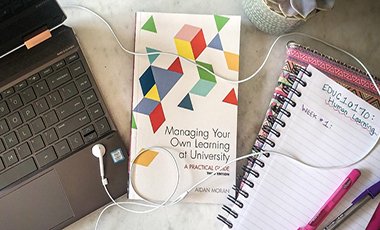
Student success at college is not just achieving high grades The National Forum for Teaching and Learning defines student success as the process by which students fulfil their potential and flourish at college and in society. This is a broader activity than simply achieving high grades. Psychosocial competencies are core to the definition of student success: these are the ‘soft skills’ or ‘non-cognitive skills’ that enable students to cope well with learning challenges, engage deeply in learning, and develop their identities as learners and as active citizens. Transitions are a key issue within this priority area, with transitions such as the move from school to college presenting both challenges and opportunities for students.
About this initiative
This project aims to improve the engagement and performance of Arts and Humanities students in foundational mathematics. By reframing Calculus I (MST10010) through interdisciplinary lenses, we seek to demonstrate the essential role of quantitative reasoning in a more relevant context for the students.
Key Deliverables
- Interdisciplinary Resource Toolkit: A curated collection of problem sets, case studies, and video explainers that teach calculus through Humanities lenses (e.g., modeling linguistic evolution or the math of architectural symmetry).
- Active Learning Environment (ALE) Lesson Plans: Redesigned tutorial and lecture frameworks for MST10010 that move away from passive delivery toward collaborative, problem-based learning.
- Digital Learning Portfolio: A dedicated, persistent Brightspace repository of “Contextualised Math” resources available to students throughout their entire degree.
- Final Implementation Roadmap: A report outlining how this “Math-to-Humanities” bridge can be scaled as a university-wide elective or adapted for other non-STEM colleges.
Expected Student Outcomes
- Reduced Math Anxiety: By using familiar Humanities contexts, students will experience lower psychological barriers to engaging with mathematical concepts.
- Enhanced Quantitative Literacy: Students will graduate with the ability to interpret data and logic within their own fields, such as digital humanities or social history.
- Improved Success Rates: A measurable increase in engagement levels and a reduction in the high D/Fail rates currently seen in foundational modules.
- Interdisciplinary Agency: Students will gain the confidence to apply “transversal” mathematical skills to complex global challenges, fulfilling the core mission of the UCD General Education project.
| Project Lead | Associate Professor Conor Sweeney |
|---|---|
| College | UCD College of Science |
| School | UCD School of Mathematics and Statistics |
| Partner College | UCD College of Arts and Humanities |
Lead organisations
Affiliated organisations
Linked open educational resources
Contributors
Related initiatives

Using Acceptance & Commitment Therapy to Reduce Academic Procrastination
Although academic procrastination is a common feature of university life (affecting 50-95% of students), research suggests it is highly problematic (Scent & Boes, 2014). Academic procrastination is associated with diminished well-being, poor quality of life, high stress, poor university performance, and university dropout (Glick & Orsillo, 2015).

Creative Writing Support
The Learning Enhancement Project set out to supplement existing writing services offered by the UCD Writing Centre, by offering support to students in creative writing. Creative Writing is one of the most successful and fastest growing subjects in the College of Arts and Humanities. With a large elective programme, the new BA in English with Creative Writing, and provision at MA, MFA and PhD levels, there is a real demand for support for creative writing students.