The HEA ESD Self-Evaluation Tool is a voluntary, developmental resource that supports higher education institutions in reviewing and strengthening whole-of-institution Education for Sustainable Development. It helps institutions undertake structured reflection on current strengths, gaps and progression, identify local priorities and plan practical next steps.
The tool is organised around the five ESD to 2030 Priority Action Areas. For each area, it provides developmental descriptors across three broad stages of practice: Emerging, Established and Leading. It is intended to support dialogue, planning and quality enhancement.
This resource sets out five strategic enablers that can support the implementation of Education for Sustainable Development across all areas of a higher education institution:
1. Collaboration and commitment
2. Holistic and transformational practice, scholarship and leadership
3. Capacity-building and professional development
4. Student partnership, engagement and leadership
5. Reciprocal learning communities
The Enablers translate national and international ESD commitments into shared language, strategic direction and practical prompts for higher education. They address curriculum, pedagogy, assessment, campus operations, governance, leadership, professional learning, student partnership, research and reciprocal engagement with communities.
The resource is designed to support institutional reflection, planning and enhancement rather than prescribe a single model. It recognises institutional autonomy, diversity of mission and disciplinary differences.
This overview introduces the Higher Education Authority’s Education for Sustainable Development (ESD) Framework for Higher Education: a connected suite of resources supporting whole-of-institution ESD across Irish higher education. It explains the Framework’s purpose, its relationship to national and international ESD priorities, and how its component resources work together to provide strategic direction, sector evidence, structured reflection, thematic insight and opportunities for peer learning.
The Framework connects curriculum, campus operations, governance, research and community engagement. It is intended for institutional leaders, educators, professional staff, students and representative bodies, ESD and sustainability leads, teaching and learning units, quality and enhancement teams, community partners and policy stakeholders.
This Podcast Series has been developed by CPID Staff involved in teaching and engaging in educational research. It consists of podcasts with well-known educational academics and experts, exploring various educational concepts/topics taught on programmes offered by the CPID, and on SATLE funded educational research projects.
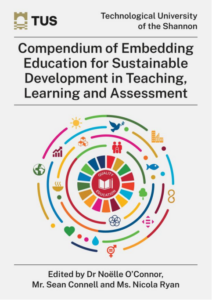
The Technological University of the Shannon (TUS) Compendium of Embedding Education for Sustainable Development (ESD) showcases the University’s commitment to integrating sustainability across teaching, learning and assessment. It is the first compendium of its kind in an Irish higher education institution.
The HEA Education for Sustainable Development Spotlight Series 2025: Case Studies Compendium brings together 115 case studies from higher education institutions across Ireland. It showcases how universities and colleges are integrating sustainability and the UN Sustainable Development Goals into teaching, research, curriculum design, assessment practices and community engagement. It offers a comprehensive picture of national ESD activity and provides an accessible resource for educators and policymakers seeking examples of practice-based innovation.
This report has been prepared for circulation across the Green-Campus Network, Higher Education Authority and the National Forum for the Enhancement of Teaching and Learning in Higher Education. It can also act as a resource for individuals who are interested in ESD and sustainability.