

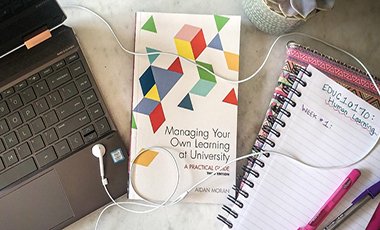
Student success at college is not just achieving high grades The National Forum for Teaching and Learning defines student success as the process by which students fulfil their potential and flourish at college and in society. This is a broader activity than simply achieving high grades. Psychosocial competencies are core to the definition of student success: these are the ‘soft skills’ or ‘non-cognitive skills’ that enable students to cope well with learning challenges, engage deeply in learning, and develop their identities as learners and as active citizens. Transitions are a key issue within this priority area, with transitions such as the move from school to college presenting both challenges and opportunities for students.
Initiative
Designing an Implementation Strategy for the Internationalisation of the Home Curriculum
About this initiative
The fundamental principle underpinning Internationalisation at Home is that all students should be offered global perspectives within their programme of study, regardless of whether they spend time abroad. This Learning Enhancement Initiative (LEI) will devise and pilot a model for the implementation of an internationalised home curriculum, with the aim of ensuring that current and future programmes incorporate international and intercultural perspectives. Key actions to be undertaken in this LEI comprise:
• A review of international best practice with regard to internationalisation of the home curriculum;
• Consultation with experts in the field;
• The design of an audit to determine the extent to which culturally diverse perspectives are explicitly evident in the programme and module learning outcomes of an existing programme; to be carried out in consultation with colleagues in the Faculty of Business and Hospitality;
• Collaboration with colleagues to identify opportunities for increased internationalisation of the home curriculum, to include:
• Internationalising learning outcomes and assessment at programme, course and module level;
• Designing teaching and learning activities and assignments that model inclusive practice, underpinned by the principle of Universal Design for Learning;
• Integrating with informal (co-)curriculum activities across the Institute and fostering inclusive engagement with international students and members of the wider community from diverse cultural backgrounds;
• Exploring opportunities for virtual mobility and collaborations.
An evaluation and refinement of the process, resulting in a model for internationalisation of the home curriculum, will be used to inform the review of current programmes and the design of future programmes across the Institute.
Lead organisations
Affiliated organisations
Linked open educational resources
Initiative details
Funding programmes SATLE
Themes Student Success
Award year
2020Funding amount (€)
18000Contributors
Related initiatives

Using Acceptance & Commitment Therapy to Reduce Academic Procrastination
Although academic procrastination is a common feature of university life (affecting 50-95% of students), research suggests it is highly problematic (Scent & Boes, 2014). Academic procrastination is associated with diminished well-being, poor quality of life, high stress, poor university performance, and university dropout (Glick & Orsillo, 2015).

Creative Writing Support
The Learning Enhancement Project set out to supplement existing writing services offered by the UCD Writing Centre, by offering support to students in creative writing. Creative Writing is one of the most successful and fastest growing subjects in the College of Arts and Humanities. With a large elective programme, the new BA in English with Creative Writing, and provision at MA, MFA and PhD levels, there is a real demand for support for creative writing students.