

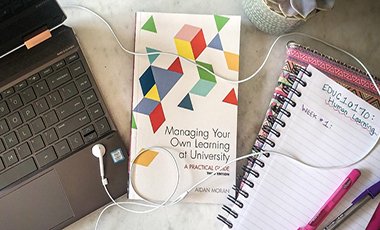
Student success at college is not just achieving high grades The National Forum for Teaching and Learning defines student success as the process by which students fulfil their potential and flourish at college and in society. This is a broader activity than simply achieving high grades. Psychosocial competencies are core to the definition of student success: these are the ‘soft skills’ or ‘non-cognitive skills’ that enable students to cope well with learning challenges, engage deeply in learning, and develop their identities as learners and as active citizens. Transitions are a key issue within this priority area, with transitions such as the move from school to college presenting both challenges and opportunities for students.
About this initiative
This initiative supports up to eighteen colleagues from the School of Humanities, the School of Lifelong Learning and Education and the School of Engineering to co-create an innovation with students, test the innovation and share the experience. The theme of the initiative is ‘closing the feedback loop’ and innovations will address studentsurvey.ie data in the following domains: student-faculty interaction, effective teaching practice, quality of interactions and supportive environment. Create ‘charters’ for individual module leaders to sign up to, the charter can be mutually agreed but would include: A commitment from the participant to:
• Undertake professional development, suggested commitment is a digital badge (25 hours).
• In response to studentsurvey.ie data, co-design and implement a feedback innovation together with students.
• Co-present with a student on the experience, e.g. as part of the institute’s CTEL Community of Practice seminar series and co-create a short video summary of the experience.
• Demonstrate a willingness to co-author a journal article through student partnership.
Top down:
• Provide supporting workshops, e.g. ethical applications, partnership workshops by NStEP
• Enable processes such as the creation of a staff/ student liaison committee.
• Curate a series of seminars and Community of Practice events on the initiative themes allowing each idea an opportunity to disseminate practice
• Use the initiative outcomes to inform policy and process development and improvement.
Lead organisations
Affiliated organisations
Linked open educational resources
Initiative details
Funding programmes SATLE
Themes Student Success
Award year
2020Funding amount (€)
60000Contributors
Related initiatives

Using Acceptance & Commitment Therapy to Reduce Academic Procrastination
Although academic procrastination is a common feature of university life (affecting 50-95% of students), research suggests it is highly problematic (Scent & Boes, 2014). Academic procrastination is associated with diminished well-being, poor quality of life, high stress, poor university performance, and university dropout (Glick & Orsillo, 2015).

Creative Writing Support
The Learning Enhancement Project set out to supplement existing writing services offered by the UCD Writing Centre, by offering support to students in creative writing. Creative Writing is one of the most successful and fastest growing subjects in the College of Arts and Humanities. With a large elective programme, the new BA in English with Creative Writing, and provision at MA, MFA and PhD levels, there is a real demand for support for creative writing students.