

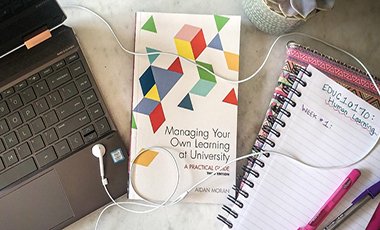
Student success at college is not just achieving high grades The National Forum for Teaching and Learning defines student success as the process by which students fulfil their potential and flourish at college and in society. This is a broader activity than simply achieving high grades. Psychosocial competencies are core to the definition of student success: these are the ‘soft skills’ or ‘non-cognitive skills’ that enable students to cope well with learning challenges, engage deeply in learning, and develop their identities as learners and as active citizens. Transitions are a key issue within this priority area, with transitions such as the move from school to college presenting both challenges and opportunities for students.
About this initiative
Under COVID-19 measures, key strands of work to re-lay the foundation of NCAD’s teaching and learning infrastructure were suspended in order to abruptly re-orient all learning and teaching practice to a remote and then blended-learning model. This initiative re-engages with those strands, encompassing an ‘Audit of Ambition and Benchmarks’ and ‘Supporting Teaching Practice’. Having established a ‘Shared Academic Ethos’ for NCAD, and building on insights gained through testing this at programme level under SATLE 2019: Stage 1 of this initiative focuses upon an ‘Audit of Ambition’ – for innovative teaching, for digitally literate graduates and for cross-disciplinary learning. Stage 2 reviews current practice against the ambitions established through stage 1. Stage 3 is a benchmarking exercise, understanding and setting current practice and ambitions for practice in relation to national and international ‘best practice’. An Audit Report, integrating findings in respect of teaching practice, digital literacy and cross-disciplinary learning, will lay the foundation for the enhancement of NCAD’s Teaching and Learning Infrastructure. Supporting Teaching Practice – A review of the audit outcome, including a gap analysis in respect of ambition and current practice, will form the basis for:
• shared priorities for the enhancement of teaching across NCAD.
• Consulting with students and staff on those shared priorities.
• Developing a Framework of Shared Priorities for Enhancement of Teaching, including through T&L enhancement-focused continuing professional development (CPD).
Lead organisations
Affiliated organisations
Linked open educational resources
Initiative details
Funding programmes SATLE
Themes Student Success
Award year
2020Funding amount (€)
30600Contributors
Related initiatives

Using Acceptance & Commitment Therapy to Reduce Academic Procrastination
Although academic procrastination is a common feature of university life (affecting 50-95% of students), research suggests it is highly problematic (Scent & Boes, 2014). Academic procrastination is associated with diminished well-being, poor quality of life, high stress, poor university performance, and university dropout (Glick & Orsillo, 2015).

Creative Writing Support
The Learning Enhancement Project set out to supplement existing writing services offered by the UCD Writing Centre, by offering support to students in creative writing. Creative Writing is one of the most successful and fastest growing subjects in the College of Arts and Humanities. With a large elective programme, the new BA in English with Creative Writing, and provision at MA, MFA and PhD levels, there is a real demand for support for creative writing students.